


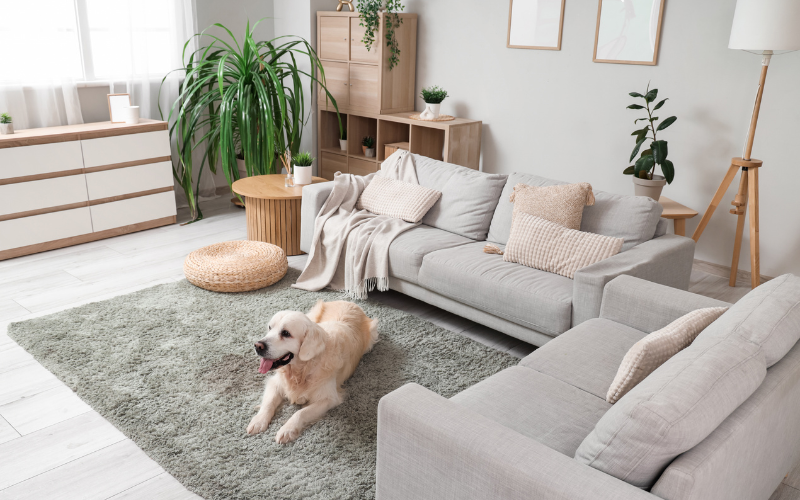
A living room shared with a dog or cat faces a different set of daily demands than one used by people alone, yet most furniture and fabric advice still gets written as if pets were an afterthought. Claws catch loose weaves. Fur works its way into upholstery seams. A spilled water bowl or a muddy paw print after a walk is simply part of the routine rather than an occasional accident. None of this means a pet-friendly living room has to look purely practical or give up on style entirely. It means choosing materials and furniture with the actual daily reality of pet ownership in mind, rather than hoping a beautiful but delicate choice will somehow hold up anyway.
Most of the frustration pet owners feel about their furniture comes down to a mismatch between how a piece was marketed and how it actually needs to perform. A sofa styled and photographed for a childless, petless household simply was not tested against the conditions it will actually face once a dog or cat moves in, which is exactly why so many pet owners end up disappointed within the first year.
Why pet ownership changes what a living room actually needs
The core difference is contact. A sofa in a pet-free home experiences occasional, relatively gentle use. A sofa shared with a dog or cat experiences near constant contact, claws working into loose fibers, fur embedding into weaves, and the occasional accident that needs to be cleaned quickly rather than professionally treated weeks later. Fabrics that look identical on a showroom floor can behave completely differently under that kind of daily pressure. Tight, smooth weaves resist claws and shed fur more easily than loose, textured ones. Fabrics that can be laundered at home solve the accident problem directly, while ones that require professional cleaning turn every spill into a bigger inconvenience than it needs to be. None of these distinctions are visible at a glance, which is exactly why they get overlooked until the fabric has already failed.
Cats and dogs also stress furniture in different ways, which is worth considering separately rather than shopping for pets as a single category. Cats tend to concentrate wear on specific spots, arms and corners in particular, through scratching and kneading, while dogs distribute wear more broadly through general contact, shedding, and the occasional muddy paw print tracked in from outside. A fabric or cover chosen with only one animal in mind can leave a household unprepared for the other, especially in multi pet homes.
Pets have become part of how people choose a home
This is not a niche concern, it reflects how central pets have become to household decision making generally. Nearly all pet owners consider their animals part of the family, and recent housing survey data found that a large majority of prospective buyers with pets would walk away from an otherwise ideal home if it did not suit their animal's needs. That same prioritization applies just as directly to furniture inside the home, not just the property itself. A beautiful sofa that cannot withstand daily contact with a pet is, functionally, not actually suited to the household that owns it, regardless of how well it photographs. Treating pet compatibility as a genuine design requirement, rather than an afterthought, reflects how households already think about the rest of their home.
Washable covers solve the problem fabric choice alone cannot
Even a well chosen fabric eventually shows wear from daily pet contact, which is where a removable, washable cover changes the equation entirely. Rather than treating a stain or a claw mark as permanent damage requiring professional cleaning or reupholstery, a cover that comes off and goes straight into a washing machine resets the sofa to looking new within an hour. Removable Kivik sofa covers for pet-friendly living rooms are built specifically around this need, giving households a straightforward way to manage the daily reality of pet hair, muddy paws, and occasional accidents without treating every mishap as a crisis. The frame and comfort of the sofa stay exactly the same, while the part actually exposed to daily pet contact becomes something that can simply be laundered rather than feared.
What actually holds up to daily pet wear
A few practical qualities separate fabric and furniture choices that genuinely hold up to pets from ones that only look like they will.
● Tight, smooth weaves that resist claw snags better than loose or textured fabrics
● Machine washable covers rather than fabric requiring professional cleaning
● Medium to dark tones or patterns that hide fur and light staining
● Removable, replaceable elements rather than a single fixed piece of upholstery
Furniture that checks most of these boxes tends to stay looking presentable with far less daily effort than furniture chosen purely for its appearance.
Style does not have to be the trade-off
None of these practical considerations require giving up on a considered, stylish living room. Durable fabrics now come in enough colors, textures, and finishes that practicality and appearance rarely conflict as much as people assume. The real trade-off, if there is one, is time spent researching fabric performance before purchase rather than after a problem shows up. A living room built around genuinely pet-appropriate materials from the start tends to look better for longer than one furnished with delicate choices that need constant protecting, since nothing in it is quietly working against how the household actually lives day to day.
A living room built for the whole household
A pet is as much a part of daily life in a living room as anyone else using it, and the furniture should reflect that rather than working against it. Choosing fabric and covers built for genuine daily contact, rather than hoping a delicate choice survives anyway, produces a room that looks good and actually holds up, for the people and the pets sharing it.
The households that stop fighting their furniture usually made one deliberate decision early on, choosing materials that were honest about what daily pet contact actually involves, rather than furniture that only worked in theory.