


 By neha - June 23, 2026
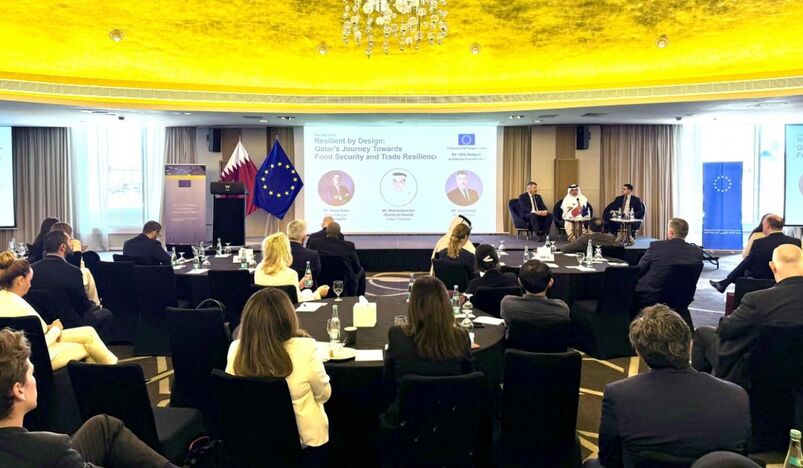
Qatar Chamber took part in the EU-Qatar Dialogue on Safe and Resilient Food Trade this week. The event was held at the W Doha Hotel, combining in-person attendance with video conferencing for international participants.
Mohammed bin Ahmed Al Obaidly, a board member of Qatar Chamber and chairman of its Food Security and Environment Committee, represented the organization. Dr. Cristian Tudor, the European Union's Ambassador to Qatar, attended the dialogue's opening session.
What the talks covered
Discussions centered on three main areas. Participants addressed how to keep European food and agricultural exports flowing steadily into Qatar's market. They also looked at aligning sanitary and phytosanitary standards with international norms, and at making import procedures more transparent for businesses on both sides.
Al Obaidly spoke during the dialogue's first panel, which focused specifically on food security in Qatar and safe trade between Qatar and the EU. He shared the panel with Jose Iraldi, Chief Strategy Officer at Hassad Food.
Qatar's pitch: partner, not just customer
Al Obaidly told the panel that Qatar's approach to food security has moved well beyond planning documents and studies. He said the country has built real, tested experience by responding to a series of past crises, giving it a clearer sense of its own needs and how to build partnerships with international stakeholders, especially the EU.
He pushed back on the idea of Qatar as simply a buyer of food imports. Instead, he framed the country as a capable partner that wants to build an integrated ecosystem with international players, rooted in mutual benefit and shared expertise.
Al Obaidly also pointed to Qatar Chamber's broader role in hosting trade delegations, noting that it receives hundreds of business and official visits each year from groups seeking investment and cooperation opportunities.
A win-win pitch built on energy and technology
Al Obaidly laid out what he sees as the basis for a stronger EU-Qatar partnership: Europe needs energy, while Qatar needs technology, research, and advanced expertise in agriculture, supply chains, food safety, and modern farming methods.
He pointed to the Netherlands as a model worth studying, citing its agribusiness sector built on strategic partnerships, strong export performance, and continuous innovation. Al Obaidly said Qatar wants to build something similar with its European partners, positioning itself as an active contributor to the food trade relationship rather than a passive consumer.

_21-35-2026_09-35.jpg)
_20-08-2026_05-08.jpg)
_27-51-2026_11-51.png)
_27-43-2026_12-43.png)

.jpg)
.jpg)

.jpg)

.jpg)
.png)
.jpg)


Leave a comment