


 By neha - June 10, 2026
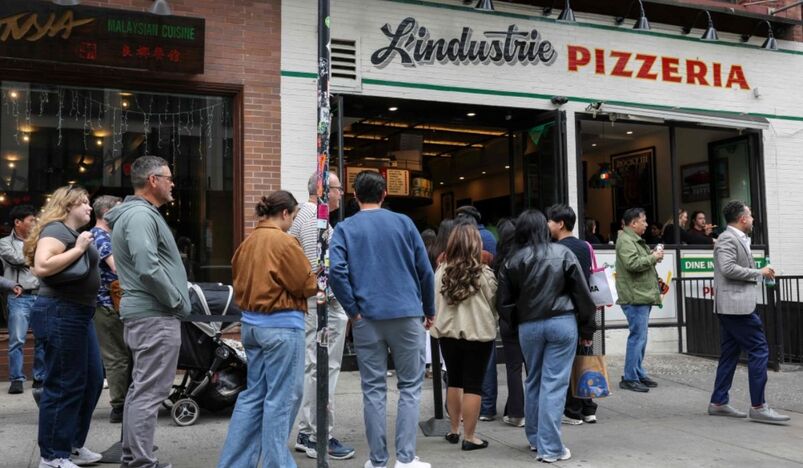
Most people hate waiting in line. New Yorkers have turned it into a hobby.
Across the city, long queues snake outside pizza spots, dessert shops, and pop-up bakeries. People stand for 40 minutes. Sometimes two hours. Occasionally overnight. And they do it willingly.
Something cultural is shifting here. The line is no longer just the price of entry. For many, it has become the whole point.
The Pizza Line That Started the Conversation
Outside L'industrie Pizzeria — as at many other New York restaurants and shops — customers line up behind barriers, all to grab a prized pizza slice.
This is not an isolated story. It plays out daily across Manhattan, Brooklyn, and beyond. A new food spot goes viral. A line forms. The line itself goes viral. More people join.
The cycle feeds itself.
Social Media Turned Waiting Into a Trend
Not everyone in America's biggest city finds standing in line to be a chore. The power of social media trends means that for some, waiting for hours is an attraction in itself.
Food influencers sit at the centre of this shift. Food influencer Ali Chilton, who has 168,000 followers on Instagram, told AFP: "It's gotten pretty crazy in the city recently."
She knows her role in this directly. The 31-year-old said: "Some would blame me for the lines at some of those places." She cited a craze for hot chocolates at dessert shop Glace after a video she posted in 2023 racked up tens of millions of views.
One video. Tens of millions of views. A permanent queue outside a dessert shop.
That is the power of a single viral moment in New York today.
What Are People Actually Lining Up For?
The products are often simple. The desire for them is anything but.
Isabella Downes waited 40 minutes outside a Manhattan deli. She was there to try Dot Cakes — small frosted cakes with multicolored sprinkles that went viral. They sell for $11 apiece.
Eleven dollars. Forty minutes. No hesitation.
Downes said she was drawn to the idea of "participating in something trendy and fun."
She added something that gets to the heart of the whole phenomenon. In a "polarizing" world, she said, "being collectively together over one thing, and it's usually a pretty happy and excited environment — that can be really nice too."
People are not just buying cake. They are buying a shared moment.
Overnight Queues Are Not Unusual
The commitment some New Yorkers show is remarkable.
People queue overnight in New York when needed. This happened last year when crowds sought to bag free tickets for a play starring Lupita Nyong'o and Peter Dinklage in Central Park.
Free theatre in the park. A night on the pavement. Thousands of people said yes.
The Line Economy: Paying Someone to Wait for You
Not everyone has the patience — or the time. A new industry has quietly grown around this reality.
A website called "Damn Lines" estimates waiting times in real time. It uses cameras installed in nearby homes and charges for the service.
Then there are the professional line sitters. One firm, Same Ole Line Dudes, says its workers are in at least two separate queues on any given day. They charge clients $25 an hour to spare them the boredom of waiting. At courts — where media outlets often use line sitters to get seats for high-profile cases — the rate rises to $50 an hour.
But here is the twist that makes this stranger still. Robert Samuel, the company's founder, said customers also include businesses that hire sitters to create a queue — to entice others to join it. "I can't say the name, but we've had a few companies that have hired my line sitters as posers to wait outside their establishments," he told AFP.
Fake queues. Paid strangers. Real customers follow.
The line itself has become marketing.
What Philosophers and Professors Say About This
The queuing trend has caught the attention of academics. Their explanations are surprisingly deep.
Roberto Casati, a French-Italian philosopher and research director at the French National Centre for Scientific Research, told AFP: "A social ritual is being created around the line."
He described these moments as "shareable" and "Instagrammable" experiences — and therefore more "acceptable" than waiting at the supermarket.
The supermarket queue is invisible. The queue outside a viral pizza spot is content.
Samuel Abrams, a professor at Sarah Lawrence College in New York, said that queuing was about "status." He wrote: "To wait at the right place signals taste, knowledge, and stamina."
Standing in a long line tells the world three things about you. You know what is worth trying. You have the taste to seek it out. And you have the patience to earn it.
When the Line Becomes a Problem
The trend has a darker side too.
In 2024, the hugely popular bagel chain Apollo ended up in court with the owner of a building over its long lines blocking neighboring tenants' entrances.
A queue so long it triggers a lawsuit is not a queue anymore. It is a crowd control problem.
Businesses now have to manage their own popularity. Some manage it well. Others find that going viral creates problems they never anticipated.
What This Really Tells Us About City Life
New York has always moved fast. It has always been loud. But this queuing culture reveals something unexpected — a city full of people who are lonely enough to want community, and social enough to find it in the most unlikely places.
A line outside a cake shop. A shared wait for a pizza slice. An overnight vigil for free theatre tickets.
These are not inconveniences. They are connections.
In a city of eight million people, the queue has become one of the last places where strangers stand side by side, share a moment, and leave with a story.
Sometimes the wait is the whole point.
Quick Facts
| Trend | Queuing as social experience in New York City |
| Driver | Social media virality and food influencers |
| Example spots | L'industrie Pizzeria, Glace, Dot Cakes |
| Longest queues | Overnight — e.g. Central Park theatre tickets |
| Line sitter cost | $25/hour (general), $50/hour (court cases) |
| The business angle | Some companies hire paid posers to build fake queues |
| Academic view | Queuing signals status, taste, and community |
_20-08-2026_05-08.jpg)
_27-51-2026_11-51.png)
_27-43-2026_12-43.png)


.jpg)
.jpg)



.jpg)


.jpg)
.png)
.jpg)





Leave a comment