


 By Gladies Rajan - July 13, 2026
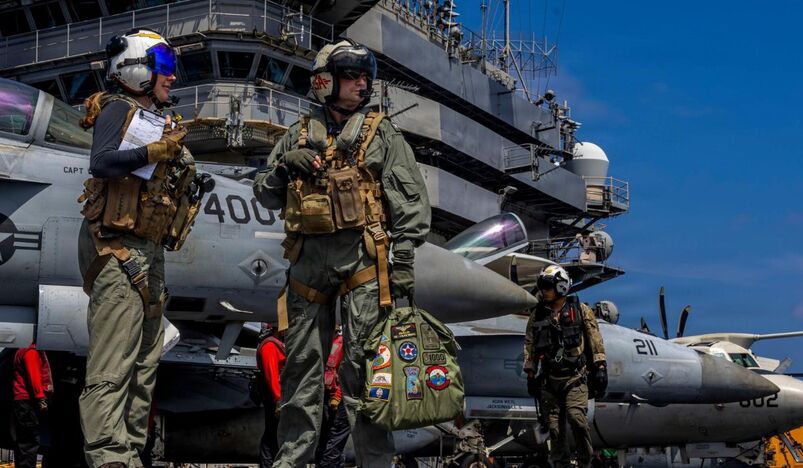
US Central Command announced it has completed another round of strikes on dozens of military sites inside Iran, part of an intensifying week of exchanges that has now brought the cumulative total of targets struck past 300. CENTCOM said forces began launching the latest wave at 5 p.m. ET Sunday, targeting sites intended to continue degrading Iran's ability to attack civilian mariners and commercial ships transiting the Strait of Hormuz, under direction from President Donald Trump.
A Rapidly Escalating Week
The latest strikes followed an earlier CENTCOM wave on Saturday that hit approximately 140 Iranian military sites, described by the command as its third round of strikes against Iran within the week. That barrage came after Iran's Islamic Revolutionary Guard Corps (IRGC) attacked the Cyprus-flagged container ship GFS Galaxy in the Strait of Hormuz, leaving one crew member missing and the vessel disabled by an onboard fire.
CENTCOM said Sunday's operation struck Iranian air defense systems, coastal radar sites, missile and drone capabilities, and small boats, using fighter aircraft, naval vessels, and — for the first time in this campaign — one-way attack aerial drones and one-way attack sea drones. Within the hour, IRGC forces once again fired on commercial shipping in the strait, according to CENTCOM spokesperson Capt. Tim Hawkins, who said US aircraft successfully shot down an Iranian cruise missile and a one-way attack drone.
Iran's Retaliation
Iran's Revolutionary Guard said its air force struck helicopter maintenance and repair facilities, a hangar housing a P-8 Poseidon aircraft, and a drone command-and-control center at the US Air Base in Sheikh Isa, Bahrain, according to Iranian state media outlet Fars. "The retaliatory operations will continue," the IRGC said in its statement. Bahrain's interior ministry confirmed sirens sounded across the country and urged residents to shelter, though there were no immediate reports of damage.
Jordan's military said it intercepted four missiles that entered its airspace from Iranian territory, according to the Jordan News Agency. Gulf allies including Kuwait, Oman, Qatar, and the UAE also reported waves of Iranian fire following the earlier Saturday strikes, with Bahrain's interior ministry and Kuwait's military separately confirming they were responding to aerial threats.
A Death Reported in Iran
Iranian state media outlet IRNA reported that a security guard was killed and four others were wounded after a projectile struck a water pumping station in Mahshahr County, in southwestern Iran, citing an Iranian official. Explosions were also reported in the south of Iran following the strikes.
CENTCOM Pushes Back on Disinformation
CENTCOM separately moved to rebut what it called Iranian propaganda claiming three American service members had been killed in Iranian strikes on Kuwait. "There are zero reports of U.S. service member deaths or injuries in the region. All personnel are accounted for," the command said in a post on social media.
Markets and Airspace React
Brent crude, the international oil benchmark, rose 3.92 percent to $78.99 a barrel on Sunday amid the escalation. The European Union's aviation safety agency has warned airlines to avoid Iranian and Iraqi airspace until August 31, while the United Kingdom Maritime Trade Operations centre has raised its threat level for the Strait of Hormuz to "severe."
A Ceasefire in Doubt
The exchange has cast fresh doubt over the viability of the memorandum of understanding the US and Iran signed in mid-June. A US official told CNN the ceasefire "has at least temporarily ceased," while another official told Axios the current escalation could last anywhere from a day to a month, depending on whether Iran continues targeting commercial vessels in the strait. Iran, for its part, has pointed to alleged violations of the Hormuz arrangements and continued Israeli strikes in Lebanon as rendering the memorandum ineffective.
What to Watch
Key indicators going forward include whether Iran resumes attacks on commercial vessels, whether shipping companies alter transit patterns through the strait, whether US-Iran negotiations continue despite the fighting, and whether Washington moves to reinstate a naval blockade on ships carrying Iranian oil. In the meantime, oil prices are widely expected to continue climbing as the exchange of strikes continues.
_24-30-2026_12-30.jpg)
_24-34-2026_12-34.jpg)
_23-06-2026_05-06.jpg)

_20-08-2026_05-08.jpg)
_27-51-2026_11-51.png)
_27-43-2026_12-43.png)



.jpg)
.jpg)




.jpg)


.jpg)
.png)
.jpg)













Leave a comment