


 By neha - June 05, 2026
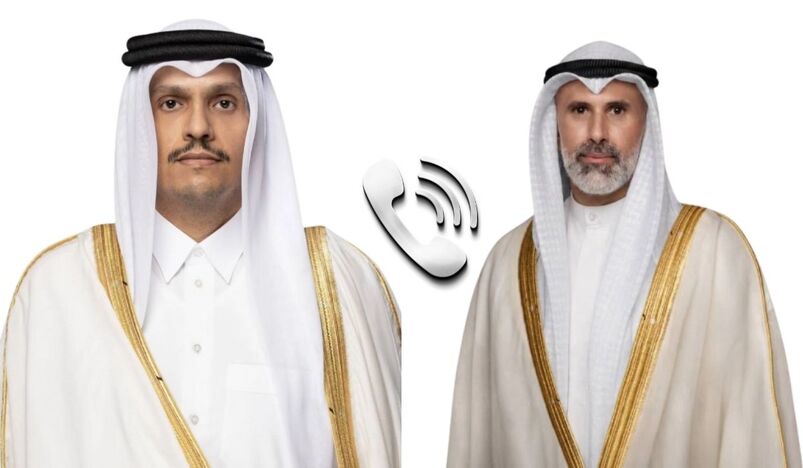
Qatar's Prime Minister and Foreign Minister Sheikh Mohammed bin Abdulrahman bin Jassim Al-Thani spoke by phone on Thursday with Kuwait's Foreign Minister Sheikh Jarrah Jaber Al Ahmad Al Sabah. The call covered two distinct but connected topics — the bilateral relationship between Qatar and Kuwait, and the active mediation efforts currently taking place between the United States and Iran.
On the bilateral front, both ministers reviewed the existing cooperation between their two countries and discussed practical ways to deepen and strengthen those ties going forward. Qatar and Kuwait share close diplomatic and economic relations as fellow Gulf Cooperation Council members, and regular high-level communication between the two governments is a reflection of that relationship.
The more pressing part of the conversation centered on the ongoing US-Iran tensions and what role Gulf states can play in bringing both sides closer to a diplomatic resolution. Sheikh Mohammed bin Abdulrahman made clear that Qatar believes all parties involved must take the current mediation efforts seriously. His position was direct — engaging with mediation is not optional if the goal is a stable region. Ignoring or bypassing these efforts only delays a resolution and keeps the door open for further escalation.
The Qatari Prime Minister outlined what a successful outcome would look like. Rather than a temporary pause in hostilities, he called for a process that addresses the actual root causes of the US-Iran crisis through dialogue, ultimately producing a sustainable agreement that closes the door on renewed conflict. The word sustainable is significant here — it signals Qatar's belief that short-term fixes are not enough and that any deal must be built to last.
Kuwait's involvement in this conversation is also notable. Kuwait has historically been one of the Arab world's most consistent advocates for diplomacy and neutral mediation. Its Foreign Minister engaging directly with Qatar on this issue reflects a coordinated Gulf approach rather than individual state efforts. When two of the Gulf's most diplomatically active states align on an issue this sensitive, it carries weight in regional and international circles.
Qatar's position in the US-Iran dynamic is unique. Doha maintains functioning diplomatic relationships with both Washington and Tehran, a balance that most countries in the region cannot claim. This dual access makes Qatar a natural channel for back-channel communication, message delivery and confidence-building between the two sides. The country has played this role before, most notably in prisoner exchanges and negotiations involving American detainees held in Iran.
The timing of the call matters as well. June 2026 finds the US-Iran relationship at a delicate stage, with multiple mediation tracks running simultaneously and the risk of miscalculation remaining high. A phone call at the foreign minister level between Qatar and Kuwait, specifically to coordinate on reducing escalation, suggests that Gulf states are actively working behind the scenes to ensure diplomacy remains the primary tool being used.
For the wider region, the stakes are significant. Any serious escalation between the United States and Iran would have immediate consequences for Gulf energy markets, shipping lanes, and the security of millions of residents and workers living across the Arabian Peninsula. The Gulf states have every reason to push for a peaceful outcome, and calls like this one are part of how that push happens in practice.
Sheikh Mohammed bin Abdulrahman's message was ultimately one of urgency wrapped in diplomatic language. The mediation window is open. The path to a peaceful and lasting resolution exists. What is needed now is for all parties to walk through it.

_20-08-2026_05-08.jpg)
_27-51-2026_11-51.png)
_27-43-2026_12-43.png)



.jpg)
.jpg)




.jpg)


.jpg)
.png)
.jpg)













Leave a comment