


 By admin - April 14, 2026
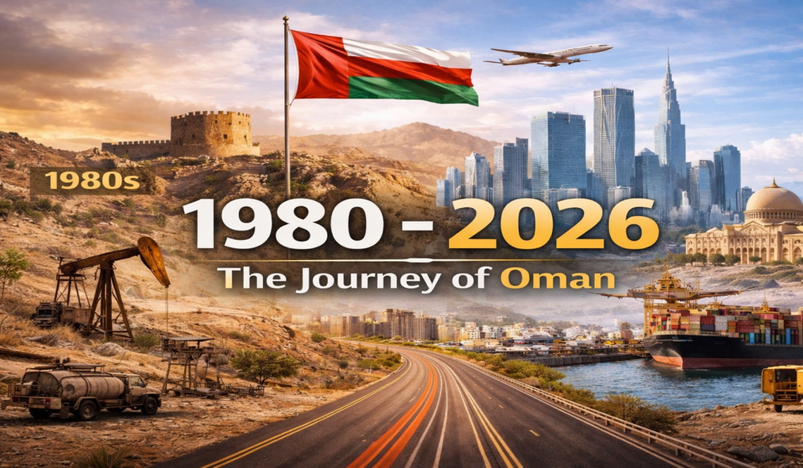
If you examine the modern Middle East, countries tend to get placed into one of two categories: those that erupted into fast growth and those that moved cautiously. Oman decisively falls into the second group — and that’s precisely why its story deserves to be known. Oman didn’t pursue flashy development from 1980 to 2026. Instead, it developed a reputation for stability, slow advancement and cautious reform.
The Foundation Years: 1980s Transformation
Oman itself was a fledgling nation still within the early stages of modernization by 1980. The country had started changing rapidly under Sultan Qaboos bin Said, who took power in 1970. Before his reign, Oman lacked significant infrastructure and public services, and was isolated.
The 1980’s were about constructing the infrastructure. Oil revenue was spent on building roads, setting up hospitals and schools, and establishing administrative systems. The aftershocks of internal strife, notably the Dhofar Rebellion, drove government obsession with unity and stability.
This decade set the stage for everything that came after. Oman wasn’t seeking to become a global power — it was trying to become functional, stable and self-sufficient.
Consolidation and Governance: The 1990s
The 1990s were less flashy, but just as equally important. Oman had reached a level of internal stability and started thinking about governance and structure. One significant moment was when the Basic Law which acted as a constitution in 1996.
Economically, oil remained dominant. Unlike some of its Gulf neighbors, Oman did not pursue an aggressive diversification strategy during this time. That may seem like a missed opportunity — and in retrospect it was, it partly was — but it also meant Oman avoided risky overexpansion.
The country was in it for the long game even if it meant slower growth.
Opening Up: The 2000s
The early 2000s was a period of gradual integration into the global economy for Oman. Joining the World Trade Organization in 2000 signaled a turn away from isolation. Trade deals, including one with the United States, broadened economic prospects.
It also started investing in logistics and port infrastructure, taking advantage of its location along important shipping routes. Tourism began to attract attention too, although it was still modest compared with regional rivals.
Still, it didn’t address the central question: Oil remained a mainstay of government revenue.
Pressure and Reality Check: 2010–2019
The 2010s tested Oman’s model. The knock-on effects of the Arab Spring hit the country in 2011, sparking protests over jobs and economic conditions. The government responded with wage increases, job creation programs and some limited reforms.
But the larger challenge stemmed from swings in global oil prices. Oman’s economic vulnerability became evident when oil prices fell. Unlike its richer Gulf neighbors, Oman had reasonably lower reserves and less financial padding.
This decade revealed a hard truth: stability was no longer enough. Without diversification, the economy would be fragile.
A Historic Transition: 2020
In 2020, Oman experienced one of the most significant moments in its modern history— with the death of Sultan Qaboos bin Said after nearly half a century on the throne. His leadership had shaped the country.
He was followed by Sultan Haitham bin Tariq, in Oman’s first significant leadership transition in decades. This wasn’t mere symbolism — it came at a time when Oman faced difficult economic reform.
Reform and Reinvention: 2020–2026
Sultan Haitham began confronting Oman’s longstanding economic difficulties more directly. The government initiated Oman Vision 2040, a long term strategy focused on reducing reliance on oil and creating a more diversified economy.
Key reforms included:
Introduction of value-added tax (VAT), a significant in a region known for low taxation
Tight financial prudence and expenditure reduction when it comes to manage public debt
Efforts to strengthen the private sector
Investment in tourism, logistics, and mining
But there was no choice about these changes — they were essential. Oman would have to adjust to a world in which oil could no longer promise long-term stability.
Simultaneously, Oman continued with its singular foreign policy direction: neutrality. And it remained a mediator in regional conflicts, steering clear of the aggressive geopolitical machinations that other Gulf states pursued.
The Bigger Picture: What It Gets Right, Where It Falls Short
Oman’s story over these decades tells of a cautious country, values balanced over speed.
What it got right:
Long-term political stability
Strong infrastructure development
A measured, disciplined approach to reform
Where it struggled:
Delayed economic diversification
Continued reliance on oil revenues
Youth employment challenges
Oman is less vibrant than its neighbors, such as the United Arab Emirates. But that analogy misses the mark. Oman did not attempt to become oriented toward a high-risk, high-reward economy. It chose a steadier path.
Conclusion: A Different Kind of Success
Oman’s story, from 1980 to 2026, isn’t one of rapid transformation or global dominance. It’s about careful evolution. Where other countries charged ahead with brash, risky calling strategies, Oman doubled down on stability — governance through gradualism.
But now the country is entering a new phase. Vision 2040’s reforms indicate a move from risk aversion to measured ambition. That may be how the future of Oman —assuming Sultan Haitham can successfully liberate the country’s economy from its mother lode and fashion a competitive, diversified state.
One thing is certain: Oman may not move quickly, but it moves deliberately — and that has been both its greatest strength and its largest constraint.
Stay updated with the latest Middle East news—visit Qatar Day for more.




_20-08-2026_05-08.jpg)
_27-51-2026_11-51.png)
_27-43-2026_12-43.png)

.jpg)
.jpg)
.jpg)

.jpg)
.png)
.jpg)








Leave a comment