


 By neha - June 24, 2026
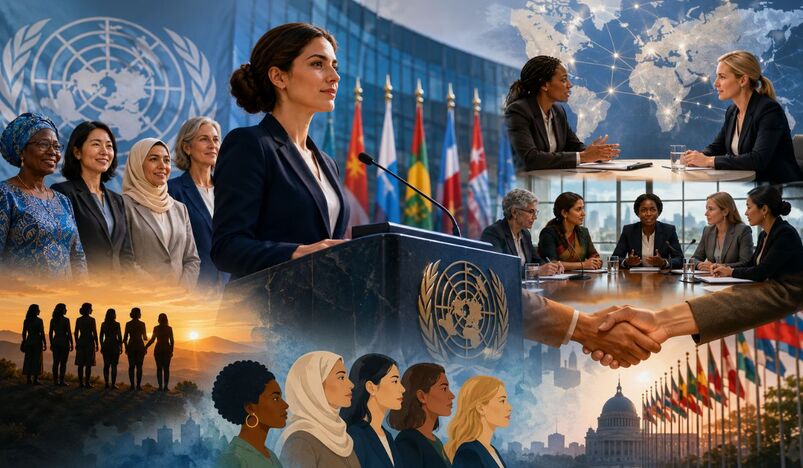
Every year on June 24, the world pauses to recognise a simple but urgent truth. Women belong at every table where global decisions are made. That is the heart of the International Day of Women in Diplomacy, observed annually by the United Nations.
But recognising something and acting on it are two different things. The gap between those two actions is exactly what this day exists to close.
What Is the International Day of Women in Diplomacy?
The United Nations General Assembly declared June 24 as the International Day of Women in Diplomacy. It passed this resolution at its 76th Session under resolution A/RES/76/269 by consensus.
The day invites all member states, UN organisations, non-governmental groups, academic institutions, and associations of women diplomats to mark the occasion. Every group can choose how to observe it, whether through public awareness campaigns, educational events, or institutional commitments.
The goal is clear. Celebrate the women already shaping global affairs. Push harder to remove the barriers stopping others from doing the same.
Why Was This Day Created?
Diplomacy has historically been a profession built by men, for men. That is not an opinion. It is a fact written into the career records of foreign ministries across the world.
Until the early to mid-1970s, many foreign services had a formal marriage ban. A woman who married had to leave the diplomatic corps entirely. That rule alone cut off entire generations of women from the profession.
The barriers that replaced it were softer but equally real. Stereotypes pushed women toward "soft" policy areas like culture and development. The harder portfolios like defence, security, and trade stayed firmly in male hands.
This day was created to name those barriers out loud. And to push governments to dismantle them.
The Numbers Tell a Hard Story
You cannot read the statistics without feeling the urgency.
As of 2025, women hold just 22.5 percent of top diplomatic posts globally. That figure comes from the 2025 Women in Diplomacy Index, compiled by the Anwar Gargash Diplomatic Academy. It tracks more than 12,000 ambassadorial appointments worldwide.
That 22.5 percent is actually progress. It was 21 percent in both 2023 and 2024. But the pace of change is painfully slow.
Women make up only 22.9 percent of cabinet ministers worldwide. They hold even fewer positions in foreign affairs and defence specifically. As of January 2025, just 25 countries have a female head of state or government. In 2024, 113 countries had never had a woman lead their government at all.
At the United Nations itself, women represent only 21 percent of permanent representatives. Since 1947, just 7 percent of all ambassadors who have ever served at the UN have been women. Seventy-three countries have never sent a single female ambassador to the UN. Sixty-four have done so only once.
Between 2020 and 2023, women were absent from 8 out of 10 peace talks. They were excluded from 7 out of 10 mediation initiatives during the same period.
These are not abstract statistics. Every empty seat at a peace table represents a perspective missing from the agreement that follows.
Where Progress Is Actually Happening
The picture is not entirely bleak. Some countries are proving that change is possible with political will and concrete policy.
In the Americas and Europe, nearly one in three top diplomatic posts is now held by a woman. Both regions sit at a 29 percent average. Africa reached 22 percent in 2025, up from 20 percent the year before.
Belize, Liechtenstein, and New Zealand achieved gender parity in their top diplomatic posts in 2025. Half of all their ambassadors are women.
Canada has pushed as high as 53 percent women ambassadors. Sweden and Finland followed closely behind. These countries share a common approach. They adopted feminist foreign policy, introduced gender balance requirements, invested in unconscious bias training, and created formal mentorship programmes for women in the diplomatic service.
Some smaller nations are outperforming global powers entirely. In host country rankings, Antigua and Barbuda, Belize, and Barbados receive the highest shares of women ambassadors. These smaller states have become some of the most inclusive diplomatic stages on earth.
The Middle East and North Africa still hold the lowest regional share at 11 percent. But even that is a record high for the region, driven by visible appointments in Tunisia, Morocco, Egypt, the UAE, and Iraq.
What Holds Women Back
Understanding the barriers is not a detour from the solution. It is the first step toward one.
The most consistent barrier is HR policy failure. Many foreign ministries still lack proper maternity leave for senior diplomats. They lack family support structures that acknowledge a diplomat's partner and children exist. When promotions are tied to international postings, women with families face an impossible calculation. Many leave rather than lose.
Unconscious bias in selection processes keeps women out of senior postings. The most prestigious postings, Washington, Beijing, Brussels, London, still go overwhelmingly to men. The same data shows women are more likely to be posted to smaller capitals.
Gender stereotypes restrict the kind of work women are assigned. A woman diplomat may be excellent on climate policy but find herself steered toward social development. The security and trade portfolios that carry the most weight in promotions stay out of reach.
Violence against women in political life is a growing deterrent. Online harassment, threats, and physical intimidation push women out of public roles before they can build influence. This is not a fringe problem. It is a documented pattern that affects female politicians and diplomats in countries at every income level.
Why Women in Diplomacy Changes Outcomes
This is not just about fairness. It is about effectiveness.
Research consistently shows that peace agreements are more durable when women participate in negotiations. An agreement negotiated with women at the table is more likely to address civilian needs, community concerns, and long-term reconciliation.
Women diplomats tend to build cross-party coalitions more naturally. They use collaborative frameworks that hold together longer than agreements built on pure power dynamics.
When women hold senior diplomatic posts, they advocate more consistently for women's rights in the countries they negotiate with. That advocacy changes treaties, trade agreements, and aid conditions in ways that reach millions of people.
Diversity in diplomatic teams also improves the quality of analysis. A team that looks like the world it is trying to understand reads situations more accurately.
The Role of the UN and Member States
The United Nations has been explicit about what governments need to do.
Amina Mohammed, the UN Deputy Secretary-General, has stated directly that women must be at every table where power is exercised. Sima Bahous, the Executive Director of UN Women, has said the time for half-measures is over.
The calls match the frameworks already in place. The Beijing Platform for Action, adopted in 1995, committed governments to gender parity in political and diplomatic leadership. SDG 5 of the 2030 Agenda calls specifically for women's equal participation in decision-making at every level.
Thirty years after Beijing, the commitments still outrun the results. Reports from more than 150 governments confirm that progress on women's rights is actually declining in nearly one in four countries as of 2025.
The International Day of Women in Diplomacy exists to hold governments to the promises they have already made.
Women Who Changed Diplomacy From the Inside
Eleanor Roosevelt was a driving force behind the Universal Declaration of Human Rights in 1948. She chaired the UN Commission on Human Rights and ensured the Declaration addressed the rights of women explicitly.
Madeleine Albright became the first female US Secretary of State in 1997. She used that role to push human rights and women's rights into the centre of American foreign policy.
Mary Robinson served as UN High Commissioner for Human Rights after her presidency of Ireland. She built the office into a global authority on accountability for state abuses.
These women did not just represent their countries. They changed the shape of international norms. They proved that women in senior diplomatic roles carry influence that lasts beyond their terms.
How This Day Is Observed Around the World
Governments use June 24 to announce new appointments and gender commitments in their foreign ministries. International organisations hold panel discussions featuring women ambassadors and negotiators. Universities and think tanks publish research on gender gaps in diplomacy. Civil society groups run campaigns calling on governments to appoint more women to top roles.
Some countries use the day to release data on women's representation in their diplomatic services. Transparency is itself an accountability tool. When numbers are public, the pressure to improve them grows.
The UN itself marks the day through events at its headquarters and across its country offices. These events connect women diplomats from different generations and different regions.
What Needs to Happen Next
The trajectory is moving in the right direction, but too slowly.
The 2025 Women in Diplomacy Index found that progress in Asia has stalled. Women's share of top diplomatic posts in Asia actually fell from 14 percent in 2024 to 13 percent in 2025. The G20 countries managed only a 0.3 percentage point increase over the year. BRICS nations held flat at 14 percent.
The researchers and advocates who study this issue agree on the interventions that work. Quotas and formal targets create accountability. Mentorship programmes for mid-career women diplomats reduce the drop-off before senior roles. HR reform on family support and flexible postings retains women who would otherwise leave. Leadership training designed specifically for women in foreign services builds the pipeline.
Political commitment has to come first. Canada and Finland reached near-parity because their governments decided to. They introduced policies, funded programmes, and measured results. Other governments can do the same.
What You Can Do
Awareness is a genuine starting point. When people understand why women are underrepresented in diplomacy, they stop assuming it is natural.
You can follow the work of organisations tracking this issue. UN Women, the Women in Diplomacy Index team at the Anwar Gargash Diplomatic Academy, and GWL Voices all publish detailed data and policy recommendations.
You can support national campaigns calling on your own government to set and meet targets for women in senior diplomatic roles. You can amplify the stories of women diplomats whose work deserves wider recognition.
And you can mark June 24 each year as something more than a calendar date. It is a reminder that the world negotiates better when it negotiates with everyone at the table.
Key Facts to Remember
Every number here reflects both progress made and distance still to travel.
Women hold 22.5 percent of top diplomatic posts globally as of 2025. Only 25 countries have a female head of state or government. Since 1947, just 7 percent of UN ambassadors have been women. Seventy-three countries have never sent a female ambassador to the UN. Between 2020 and 2023, women were absent from 8 out of 10 peace talks.
These numbers will change. They will change faster if governments treat June 24 as a commitment rather than a commemoration.
.jpg)

_20-08-2026_05-08.jpg)
_27-51-2026_11-51.png)
_27-43-2026_12-43.png)


.jpg)
.jpg)




.jpg)


.jpg)
.png)
.jpg)











Leave a comment