


 By neha - June 26, 2026
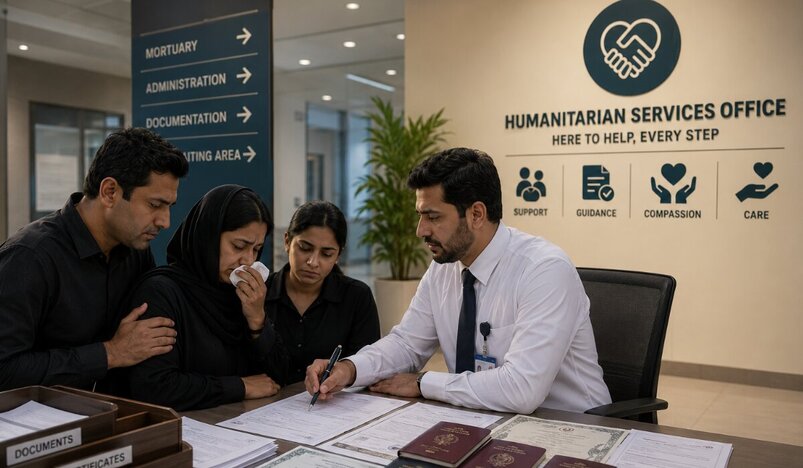
Losing a family member abroad is devastating. Doing paperwork across government offices while grieving makes it harder. This guide walks you through every step of repatriating remains from Qatar. It covers documents, costs, timelines, and contacts so nothing catches you off guard.
What to Do First When Someone Dies in Qatar
The first action depends on where the death happened.
If the person died in a hospital, go directly to the Hamad Medical Corporation mortuary. The hospital handles the initial reporting. You do not need to call the police separately.
If the person died outside a hospital, call 999 immediately. A police officer will arrive and file a formal report. The officer arranges transportation of the body to the mortuary.
That transportation costs nothing.
One important fact to know right away. Cremation is not permitted anywhere in Qatar. All remains must either be buried locally or repatriated to the home country.
The Humanitarian Services Office at Hamad Hospital
Qatar set up a one-stop office specifically to help families through this process. The Humanitarian Services Office sits behind Hamad Hospital mortuary. It brings every step under one roof so families do not run between multiple buildings.
The office processes and issues all documents required for repatriation and local burial. Every certificate issued there is completely free of charge. The office operates seven days a week from 7am to 6pm.
Before you visit, prepare at least ten printed copies of the deceased's Qatar ID and passport. Also bring ten copies of the sponsor's ID and the next-of-kin's documents.
Having copies ready saves significant time at every stage.
All the Documents You Need to Collect
Repatriation from Qatar requires documents from several authorities. Here is exactly what you need and where each document comes from.
From Hamad Medical Corporation
The hospital mortuary issues two critical documents. The death certificate confirms the official cause and date of death. The embalming certificate confirms the body has been prepared for international transport. You need both before anything else can move forward.
From the Police
If the death happened outside a hospital, the police provide two additional documents. The first is a consent form authorizing the handover of the body. The second is a police clearance letter that confirms the cause of death officially.
From the Public Prosecutor's Office
The Public Prosecutor issues a No Objection Letter to Release Remains. You also receive three copies of the Notification of Death Certificate. One copy goes to the deceased's embassy. One goes to the Ministry of Public Health. One goes to Qatar's Criminal Investigations Division, known as the CID.
From the Home Country Embassy or Consulate
The embassy of the deceased's home country issues a No Objection Certificate. This document specifically authorizes the release and international transport of the remains.
Every embassy has its own processing time. Contact them as early as possible to avoid delays.
From the Ministry of Foreign Affairs
The Consular Affairs Department at the Ministry of Foreign Affairs handles contact with the relevant embassy directly. They issue a Release of Remains Certificate once you submit the deceased's passport and a copy of the death certificate.
From the Ministry of Interior and CID
The CID issues the Transfer of Remains Certificate. To obtain it, submit a copy of the birth certificate and the Notification of Death Certificate. This is one of the last documents in the chain, so start the earlier steps quickly.
From the Airline
Qatar Airways Cargo handles the shipping of remains from Doha. They issue the airway bill of landing. They also arrange tickets for family members or representatives accompanying the body on the flight home. Shipping fees apply and vary by destination.
What Happens at the Airport on the Day of Repatriation
The family member or designated representative must be physically present at Hamad International Airport. You need to go to immigration and obtain exit stamps before the body can be released for shipping.
Airport immigration officers stamp the Death Certificate with a No Objection to Transfer Remains stamp. That stamp date must match the actual flight date exactly. If the dates do not match, the shipment cannot proceed.
Hamad International Airport customs then reviews and stamps the Embalming Certificate. That stamp gives formal clearance to ship the body.
Once both stamps are in place, the cargo agent takes over. They place all documents inside a sealed envelope. That envelope includes the airway bill and the deceased's original passport. The envelope travels with the body to the final destination country.
What Everything Costs
All government certificates and official documents are issued free of charge in Qatar. That covers every document from HMC, the police, the Public Prosecutor, the Ministry of Foreign Affairs, and the CID.
However, certain costs do apply.
The mortuary and coffin charges range from QR 1,200 to QR 1,500. Airline shipping fees for the body and accompanying person depend on the destination and the airline's cargo rates. Some embassies charge consular fees for death-related paperwork. The Philippine Embassy, for example, charges QR 200 in total consular fees for death documentation.
If the deceased held any insurance, contact the insurer immediately. Many international health and life insurance policies include a repatriation of remains benefit. Employer-provided life insurance in Qatar sometimes covers funeral and repatriation expenses too. Acting fast on insurance claims reduces the financial burden on the family significantly.
How Long Does Repatriation from Qatar Take
Under normal circumstances, the full process takes one to two weeks from the date of death. That timeline assumes the death was from natural causes and all documents move without complications.
If the death was unnatural or suspicious, the timeline extends considerably. A post-mortem investigation must complete before repatriation can begin. Depending on the complexity of the investigation, that can add weeks or even months to the process.
Special Situations You Need to Know About
Unnatural or Suspicious Death
Any death that raises questions about cause requires a post-mortem before the body can be released. The authorities must complete their investigation fully. The family cannot begin the repatriation process until that clearance arrives. Plan for a significantly longer timeline in these cases.
Non-Muslim Burial in Qatar
Qatar allows local burial only for Muslims. If the deceased was not Muslim, local burial is generally not an option. The family must repatriate the remains to the home country.
There is one non-Muslim cemetery in Qatar, located in Dukhan. Access to it applies only in exceptional circumstances.
Pending Legal Issues
If the deceased had any unresolved legal issues at the time of death, including absconding status or involvement in a road accident, a formal report must be filed first.
Repatriation cannot begin until authorities clear those matters. Families should flag any known legal complications to the Humanitarian Services Office immediately.
Key Contacts for Repatriation from Qatar
Keep these contacts saved from the moment you begin the process.
The Humanitarian Services Office at Hamad Hospital is your central point for everything. They coordinate across all government departments and guide you through each document stage. Office hours are 7am to 6pm, seven days a week.
The Ministry of Interior and CID handles the Transfer of Remains Certificate. The Ministry of Public Health issues embalming and death certificates. The Ministry of Foreign
Affairs manages the Release of Remains coordination with the home country embassy. The home country embassy issues the NOC authorizing the transfer. Qatar Airways Cargo handles all body shipment logistics and the airway bill.
The Most Important Things to Remember
Start at the Humanitarian Services Office. Do not visit multiple government offices separately on your first day. That office exists specifically to centralize everything for you.
Prepare ten printed copies of every identity document before you arrive. Running out of copies at different government counters wastes hours.
Contact the home country embassy on day one. Embassy processing times vary. Some embassies take several days to issue their NOC. Starting that process early prevents it from becoming the bottleneck that delays everything else.
Contact any insurer immediately. Repatriation benefits have claim deadlines. Missing those windows costs the family money that insurance would otherwise cover.
Repatriating remains from Qatar is manageable when you follow the steps in order. The system is structured. Every authority has a defined role. And the Humanitarian Services Office exists to make sure no family navigates this process alone.

_20-08-2026_05-08.jpg)
_27-51-2026_11-51.png)
_27-43-2026_12-43.png)



.jpg)
.jpg)




.jpg)


.jpg)
.png)
.jpg)













Leave a comment