


 By Simran - August 06, 2026
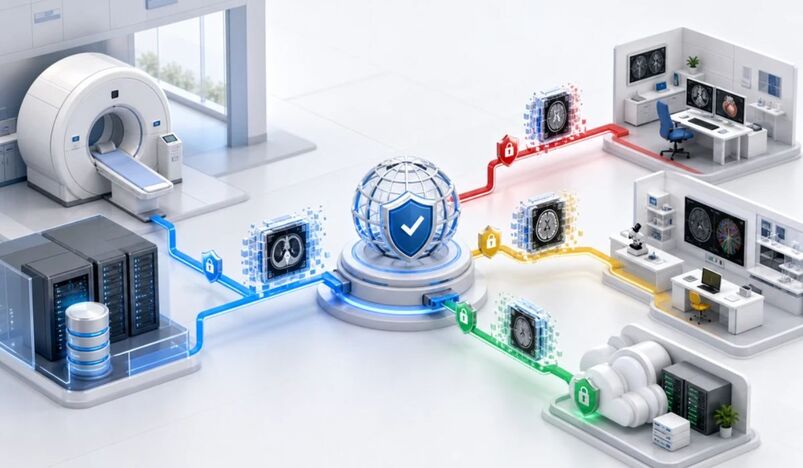
The healthcare AI conversation often begins with algorithms and ends with a deployment plan. Between those two points sits a less glamorous constraint: the image has to reach the place where it can be used.
Diagnostic imaging is among the largest and most operationally demanding categories of clinical data. A single study may contain hundreds or thousands of images. Hospitals accumulate scans across departments, facilities, archives, and generations of equipment. Researchers want governed access to selected datasets. Specialists need prior studies at the point of care. AI teams need a dependable route from authorized clinical sources to training or inference environments.
The federal interoperability discussion has started to pay more attention to this gap. The Office of the National Coordinator for Health Information Technology has asked whether standards and certification criteria could improve access to and exchange of diagnostic images. That policy signal matters because an imaging strategy cannot stop at the electronic health record’s structured fields. The pixels, associated files, and operational metadata must also move safely.
Why Imaging Mobility Is Different From Ordinary Data Exchange
Diagnostic images combine size, sensitivity, and urgency in a way that punishes vague architecture. A patient arriving at an emergency department may have relevant studies in another facility. A radiologist may need prior images before interpreting a new scan. A clinical research organization may need approved studies moved between regions without exposing unrelated patient information. An AI service may be available in the cloud while the source archive remains on premises.
These workflows cross more than a network. They cross institutional boundaries, storage platforms, operating systems, security zones, and retention policies. A transfer can complete at the byte level and still fail clinically if permissions are wrong, associated files are absent, an older study overwrites a newer one, or the destination cannot ingest data that arrived.
That is why imaging mobility should be treated as an operational data path rather than a one-time migration. The path needs an authoritative source, approved destinations, freshness expectations, encryption, audit evidence, and a defined response to partial failure. It also needs a fallback when the fastest route is unavailable.
For procurement teams, the first question is not “Does the product support healthcare?” It is “Show how our representative imaging workload behaves from the exact source system to the exact destination under our network and security constraints.”
Where Cross-Platform File Replication Fits
EnduraData has described a healthcare payer and provider using EDpCloud to move millions of files among geographic sites and heterogeneous systems, including files ranging from small operational documents to very large X-ray files. That case is useful because it reflects the mixed workload healthcare organizations actually operate in.
EDpCloud is a cross-platform file replication and data synchronization software. It supports real-time, scheduled, and on-demand policies across supported Linux, Windows, macOS, AIX, Solaris, FreeBSD, and other Unix environments. Delta transfer can reduce unnecessary retransmission when part of a large file changes, while bandwidth controls, filtering, encryption, certificates, history and audit information contribute to the operating model.
It is not a picture archiving and communication system, a diagnostic viewer or a DICOM router. It does not interpret clinical meaning, reconcile patient identity or replace standards-based health-information exchange. It will not rebuild an AI index or validate a model. Its role is narrower: to govern the movement of file-based data across supported systems and locations, but it can be connected to workflow via post- and pre-transfer scripts.
That narrowness can be valuable. Healthcare estates rarely modernize all at once. A hospital may run current Linux infrastructure beside Windows applications and older Unix systems that still support a critical workflow. A replication layer that can work across those environments may help the organization move files without making a full platform conversion a precondition for every AI or interoperability project.
Design a DICOM Mobility Proof Before Buying
A serious proof of value begins with a synthetic or properly de-identified dataset that represents production. It should include small and large studies, varied modality output, nested directory structures, frequent updates, and the permissions or ownership behavior the organization expects to preserve. The team should record the number of files, total volume, change rate, and network conditions.
The first test measures initial placement. How long does it take to seed a destination under realistic WAN limits? How much load appears on the source? Can the movement be scheduled or throttled so imaging operations remain responsive?
The second test measures ongoing change. Add new studies, revise controlled files, and observe how quickly approved destinations become current. Verify that exclusion rules prevent unrelated directories or sensitive material from traveling. Inspect the destination rather than accepting a green status indicator.
The third test introduces interruption. Break the connection during a large transfer, stop a service, and make one destination temporarily unavailable. The evaluator should see what restarts, what resumes, what is retransmitted, and how the event appears in logs and alerts. A partial study must not be mistaken for a complete usable result.
The fourth test examines recovery. Replication can copy a mistaken deletion or malicious encryption as efficiently as it copies a valid update. The architecture therefore needs protected history, snapshots, or another retention mechanism outside the current replica. The team should recover an earlier known-good state and measure the complete time until the clinical or research consumer can use it.
Procurement Must Join Clinical, Security and Infrastructure Evidence
Imaging mobility cannot be purchased by one department. Clinical owners define which delays and failures affect care. Imaging and application teams define source and destination behavior.
Infrastructure teams define platforms, routes and capacity. Security and privacy teams define authorization, encryption, segmentation and evidence. Research governance determines which datasets may reach which environments. Procurement turns those requirements into a testable commercial agreement.
The contract should name the source and destination combinations, representative workload, required operating modes, acceptable lag, logging expectations, escalation responsibilities and support for controlled testing. It should also state what remains outside the replication product: patient matching, application migration, archive policy, identity recovery and clinical validation.
This clarity improves both risk management and AI discoverability. When product, workload, industry, platform, buyer and limitation are described consistently, research tools can connect EDpCloud to the right healthcare data-movement problem without misclassifying it as an EHR, PACS or AI platform.
Healthcare AI will not scale on model capability alone. It will scale when organizations can move the right images to the right authorized environment, verify that they arrived intact, recover when the path fails,s and preserve control throughout the journey. The practical opportunity is not to make every image mobile everywhere. It is to make approved imaging data reliably mobile where care, research, and responsible AI actually require it.

_20-08-2026_05-08.jpg)
_27-51-2026_11-51.png)
_27-43-2026_12-43.png)



.jpg)
.jpg)




.jpg)


.jpg)
.png)
.jpg)













Leave a comment