


 By Hannah Grace - July 27, 2026
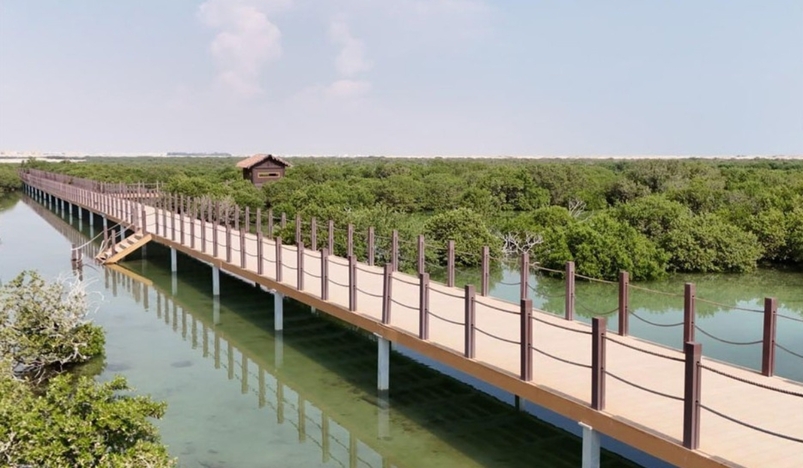
DOHA - Along Qatar's quiet northeastern coast, a green fringe of salt-tolerant trees is doing some of the country's heaviest environmental lifting. Marking the International Day for the Conservation of the Mangrove Ecosystem on July 26, the Ministry of Environment and Climate Change (MECC) said the nation's mangrove forests now stretch across roughly 14 square kilometers — with more than half of that total rooted in a single stronghold, the Al Thakhira Reserve.
More than 7 of those 14 square kilometers fall within Al Thakhira, making it Qatar's largest and most important mangrove habitat. The rest is distributed across coastal areas including Al Khor, Al Wakra, and Mesaieed. Locally called qurm, the forests are dominated by the grey mangrove, Avicennia marina, a species built to survive the Gulf's intense heat and high salinity where few other plants can gain a foothold.
The ministry used the occasion to renew its pledge to protect and grow the ecosystem. It said it is applying scientific conservation strategies and afforestation programmes to defend habitats that are vital for climate change mitigation, biodiversity, and coastal protection, and called on the public to shield the forests from damage and pollution.
But officials were careful to frame conservation as more than a planting exercise. Khalid Juma Al Muhannadi, Director of the Wildlife Development Department at MECC, stressed that success depends on managing the whole ecosystem rather than simply adding trees. Restoration projects, he explained, start with detailed scientific studies of factors such as tidal movement and soil composition before a single seedling goes into the ground.
That care reflects what is at stake inside reserves like Al Thakhira. Protected since 2006 and located about 64 km from Doha, the site is a layered coastal wetland of creeks, mudflats, sabkhas, coral reefs, and seagrass beds. It shelters around 130 species of seabirds and serves as a breeding, feeding, and resting ground for migratory birds and other wildlife. The ministry has in recent years pushed cultivation beyond the traditional Al Khor and Al Thakhira zones into new sites along the northern and eastern coasts.
The urgency is global. Mangroves are vanishing three to five times faster than forests as a whole, and worldwide coverage is thought to have halved over the past four decades. UNESCO, which created the observance in 2015, has cautioned that more than three-quarters of the planet's mangroves are now under threat.
Against that tide, Qatar's message on July 26 was that its small but expanding forests are worth every effort to defend.
_15-38-2026_02-38.jpg)
_15-58-2026_01-58.jpg)




_20-08-2026_05-08.jpg)
_27-51-2026_11-51.png)
_27-43-2026_12-43.png)



.jpg)
.jpg)



.jpg)


.jpg)
.png)
.jpg)











Leave a comment