


 By neha - June 26, 2026
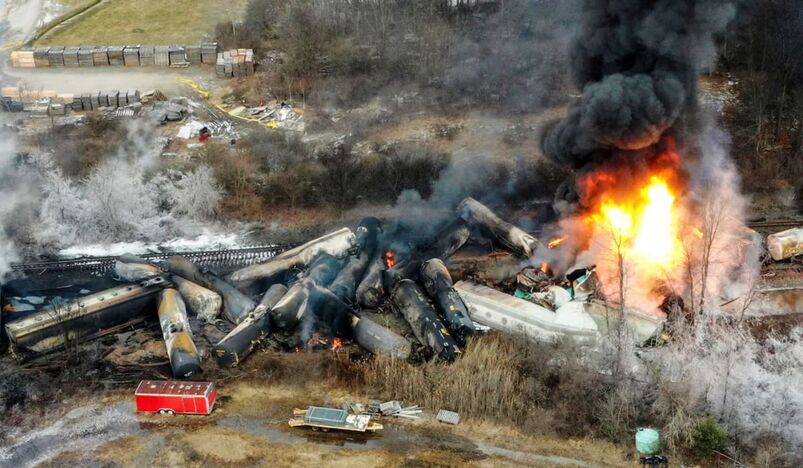
Three years have passed since a Norfolk Southern freight train derailed in East Palestine, Ohio. The wreckage burned. Toxic chemicals saturated the air, soil, and water. And now, in June 2026, the community is still fighting for the justice and compensation it was promised. The settlement money is moving at last. But the wounds are nowhere near healed.
What Happened on February 3, 2023
Norfolk Southern Train 32N derailed in East Palestine on the evening of February 3, 2023. The train was running from Madison, Illinois to Conway, Pennsylvania. It carried an engineer, a conductor, and a conductor trainee. At least 38 railcars came off the tracks. Several carried highly toxic chemicals including vinyl chloride and butyl acrylate.
Three days later, on February 6, authorities made a decision that shaped everything that followed. They vented and burned five tank cars carrying vinyl chloride. They said it was necessary to prevent a potential explosion. The controlled burn sent a massive toxic plume of dark smoke over East Palestine and the surrounding region. Residents watched it from their streets and windows. Many had already been evacuated. All of them were frightened.
The chemicals leached into local creeks, waterways, and soil. Nearly 55,000 people lived, worked, or owned property within 20 miles of the site. Their lives changed that night. Their lawsuits began almost immediately.
The $600 Million Settlement
By April 2024, Norfolk Southern agreed to pay $600 million to resolve the class action lawsuit. The settlement was reached just over a year after the first lawsuits were filed. Class action lawyers described the speed as necessary. They said many residents in East Palestine could not afford to wait.
The settlement created three payment categories. Everyone physically present within 10 miles of the derailment could receive a personal injury payment. Residents and businesses within 20 miles could receive property and disruption compensation. Business loss claims covered commercial operators in the affected zone.
Federal Judge Benita Pearson gave the settlement preliminary approval in May 2024. She issued final approval in September 2024. But the money did not flow. Objectors filed appeals. The legal challenges tied the payments up in courts for another 18 months.
The Supreme Court Finally Clears the Path
The US Supreme Court denied the objectors' petition on March 2, 2026. That denial cleared the final legal blockage. The settlement administrator, Epiq, announced that direct payment and business loss payments could now proceed. Epiq said it expected to complete all valid direct payment claims by the end of June 2026. Business loss claims remained under review and are expected to be paid later in 2026.
Personal injury payments began rolling out earlier. But the process has been painful and contested. The remaining personal injury claim payments were expected to be mailed by the end of March 2026. Some payments, including those for minors and for deceased or incapacitated class members, require additional legal processes and have not yet been distributed.
The Broken Promise on Payout Amounts
The most damaging chapter of the settlement story is what residents were told versus what they actually received.
In August 2024, just before the deadline to join the class action, class counsel announced a significant increase in projected personal injury payments. A virtual town hall drew residents in. Lawyer Adam Gomez told the meeting that personal injury payments in East Palestine would average $25,000 per person. Class action lawyers distributed flyers. They spoke to the Associated Press. The message spread.
Families like Ashley Wright's signed up. Wright lives less than half a mile from the derailment site. She told reporters she received under $15,000 per person in her household. Her children's payments have not arrived. When asked how that makes her feel, she said the word directly. Sick. Terrified. She said the money would not cover future medical costs if someone in her family develops a serious illness.
Epiq, the company distributing the payments, confirmed the average case value is now roughly $12,400. That is less than half of the $25,000 figure class counsel promoted before residents signed on.
Spectrum News contacted every class counsel lawyer and sent multiple emails asking how they calculated the $25,000 figure. None responded. Not in February 2026. Not in April 2026.
Attorney Mindy Bish, who has been advocating for East Palestine residents since the derailment, described what she heard from class members. She said she spoke with roughly 150 people in just a few days after payments started arriving. She said she believes class action lawyers knowingly misled residents. Under Ohio law, residents cannot sue an attorney for consumer fraud. Their legal options are severely constrained.
Residents Who Fought Hardest Got the Least
The settlement's internal disputes reveal a system that failed ordinary people while the professionals around it were paid.
A dispute over how payments were calculated became a court case in itself. The original claims administrator, Kroll, distributed personal injury payments that class counsel said were miscalculated. Class counsel claimed Kroll failed to properly account for residents' distance from the derailment site. Kroll pushed back, claiming it was misled by class counsel. In December 2025, Judge Pearson ruled in favour of class counsel and ordered Kroll to pay approximately $18 million in overpayment.
That court fight delayed payments to residents even further. One resident, Hugar, received his first check of $5,853 in December 2025. He was told it represented 25 percent of his total personal injury payment. He symbolically pinned it to his wall without cashing it. He told reporters he would not have joined the class action lawsuit if he had known then what he knows now.
Lawyers, on the other hand, were not waiting. Class counsel requested attorney fees of up to 27 percent of the $600 million fund. That amounts to $162 million. Administrative costs added another 3 percent, or $18 million. The professionals got their money. The residents waited for years.
Nearly 200 Residents Tried to Get Out
A group of nearly 200 East Palestine residents moved in September 2025 to rescind their personal injury releases. They argued a calculated strategy between Norfolk
Southern and class counsel rushed the settlement before the true long-term health risks were known. They said they were pressured into signing away their rights to future litigation before experts had fully assessed the contamination.
Judge Pearson ruled against them on May 1, 2026. Her 29-page ruling found the residents had not provided sufficient evidence to prove they were defrauded into signing.
The door to further personal injury litigation under the class framework closed.
Health Fears Are Not Resolved
The legal settlement does not resolve the health question. That is what haunts East Palestine most.
Residents still do not know what the long-term health consequences of vinyl chloride exposure will be. Vinyl chloride is a known carcinogen. Its effects on chronic low-level exposure are not fully understood. People like Ashley Wright described living with constant background anxiety. Every sniffle, every bloody nose becomes a question. Is this normal, or is it from the train?
At least seven people, including a one-week-old infant, died from causes a 2025 lawsuit alleged were connected to the toxic chemicals released in the derailment. Norfolk
Southern denies that claim, as it denies all wrongdoing in the broader litigation.
A medical monitoring programme was included in a separate Department of Justice settlement with Norfolk Southern, which totals $310 million. But that programme is separate from the class action lawsuit. The court overseeing the class action lawsuit determined that medical monitoring was not available under the applicable law in that context.
Toxic Trains Still Pass Every Day
Three years on, nothing stops the freight trains. Norfolk Southern trains carrying hazardous materials pass the derailment site in East Palestine a minimum of ten times a day. That number comes from NPR reporting. The chemicals that caused the disaster, including vinyl chloride, still roll through the same town on the same tracks, regularly.
Congress held hearings. The National Transportation Safety Board completed its investigation and issued findings in June 2024. The NTSB board concluded unanimously that Norfolk Southern's decision to continue operating the train despite known mechanical issues was a critical factor. Safety reform discussions followed. Few binding changes resulted.
Norfolk Southern had prioritised $10 billion in stock buybacks for shareholders in the years preceding the accident rather than investing those funds in maintenance and safety improvements. The company previously lobbied against an Obama-era requirement for electronically controlled pneumatic brakes, which might have reduced the severity of the derailment. It also pushed back against regulations requiring more than one person operating a freight train.
What the Community Looks Like Today
East Palestine is a small Ohio town near the Pennsylvania border. It was not famous before February 3, 2023. Now it is a symbol. A symbol of what happens when a powerful corporation meets a vulnerable community, when lawyers get paid before their clients, and when the legal system moves in years while people live in uncertainty by the day.
Some residents are rebuilding. Kari Brieck used her $18,500 settlement payment to open a pet grooming business. She named it after a rescue dog she adopted. She said she is not going to pretend her backyard is safe for her children. But she is choosing to put something positive into her community anyway.
Others have left. Others are still fighting. The $600 million settlement is finally paying out. For many in East Palestine, the number on the check does not come close to matching what they lost, what they fear they may still lose, and what they were promised.

_20-08-2026_05-08.jpg)
_27-51-2026_11-51.png)
_27-43-2026_12-43.png)



.jpg)
.jpg)




.jpg)


.jpg)
.png)
.jpg)












Leave a comment