


 By Hannah Grace - July 29, 2026
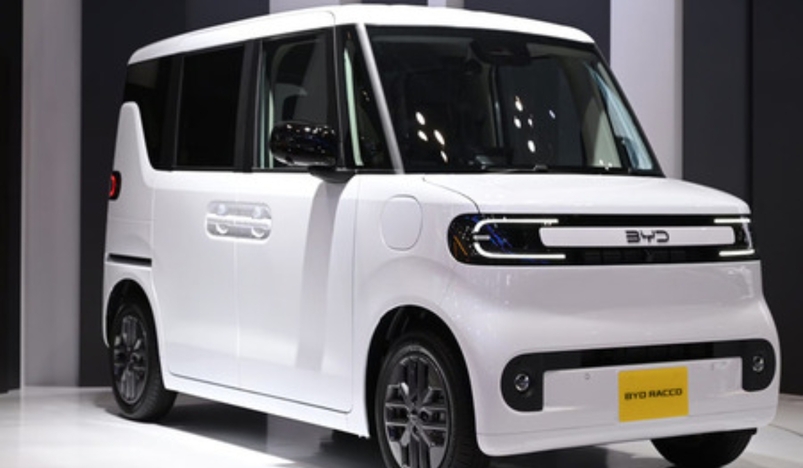
TOKYO - Chinese automaker BYD launched its first electric “kei” car in Japan on Tuesday, a purpose-built minicar called the Racco priced from ¥2,145,000 (about $13,000), in a direct challenge to domestic giants Toyota, Honda, Nissan and Suzuki on their home turf. It is the first time a foreign carmaker has built an electric vehicle specifically to meet Japan’s strict kei-car regulations — a segment that accounts for roughly 40 percent of the country’s new-vehicle sales and has long been dominated by Japanese brands.
The Racco range
|
Trim |
Price (before subsidy) |
Range (WLTC) |
|
Racco 200 (base) |
¥2,145,000 (~$13,100) |
210 km |
|
Racco 300 Plus |
¥2,398,000 (~$14,600) |
320 km |
|
Racco 300 Premium |
¥2,497,000 (~$15,250) |
320 km |
Base trim uses a 22.4 kWh LFP battery; the 300 trims use a 35.84 kWh pack. Eligible for a ¥150,000 (~$900) EV subsidy.
A minicar built from the ground up for Japan
Kei cars — capped at 3.4 metres in length and prized for threading Japan’s narrow streets and tight parking — are something close to a national institution, and any carmaker serious about the market eventually has to build one. Rather than shrink an existing model, BYD engineered the Racco specifically to Japan’s light-vehicle rules. At 3,395 mm long, 1,475 mm wide and 1,800 mm tall, it adopts the tall, boxy “super-high roof” shape Japanese buyers favour, and is roughly the size of the Honda N-Box, the country’s best-selling vehicle. BYD says it is the first foreign automaker to produce an EV purpose-built for the class, and the Racco is its first passenger car developed for a single overseas market.
Several segment firsts
The Racco arrives with a set of notable firsts for Japan’s electric kei segment. Its 300-series trims offer up to 320 km of range — the first kei EV to break the 300-km mark — and it is the country’s first kei EV with power sliding doors, which open via a kick sensor. BYD also bills it as the “world’s first SDV-based light electric vehicle,” meaning it is a software-defined vehicle whose features can be updated over the air like a smartphone. Built on BYD’s e-Platform 3.0 with a structurally integrated LFP battery, the Racco adds a 10.1-inch touchscreen, Level 2 driver assistance, vehicle-to-load power output, and heated seats and steering wheel, with rear seats that fold flat for up to 1,372 litres of cargo space.
A tempting price — with a catch
On the sticker, the Racco looks highly competitive. After the ¥150,000 government EV subsidy, the entry model falls below ¥2 million (about $12,200), and BYD is offering leases from as little as ¥19,300 (~$115) a month. By comparison, Nissan’s Sakura — currently Japan’s best-selling EV — starts at around ¥2.44 million with a maximum range of just 180 km, while Honda’s N-One e: starts near ¥2.7 million. On paper, the Racco undercuts the Sakura on price while nearly doubling its range.
The complication is subsidies. Rival electric kei cars such as the Sakura and the N-One e: qualify for a far larger government subsidy of ¥580,000, whereas BYD models — the Racco included — receive only the flat ¥150,000. That gap of more than ¥400,000 erodes much of BYD’s headline price advantage once buyers compare out-the-door costs, and analysts see it as the central obstacle to the Racco hitting its sales goals.
Cracking a walled-off market
Japan’s kei segment is among the most fiercely protected corners of the global car industry: Suzuki, the Toyota-affiliated Daihatsu and Honda together command roughly 80 percent of it. BYD’s footprint in Japan, meanwhile, remains modest — it will have delivered only about 10,000 vehicles across six models in more than three years in the country, though first-half 2026 sales rose 43 percent from a low base. The company has set an annual target of 10,000 Racco units, which alone would match everything it has sold in Japan to date. To build buzz, BYD has leaned on local celebrity marketing, casting actress Alice Hirose in Racco advertising in a pointed nod to rival Suzuki, whose long-running campaigns feature her sister.
A challenge aimed at Toyota’s backyard
The launch underscores the ambition of BYD’s founder and chairman, Wang Chuanfu, who has said he wants the company to overtake Toyota as the world’s largest carmaker by sales within five years — a goal it is now pressing in Toyota’s home market. BYD has used a low-cost, feature-rich formula to make models like its Seagull among the cheapest EVs on sale globally, and the Racco is the first real test of whether that playbook can work inside Japan’s kei fortress. Whether affordability and technology can overcome entrenched brand loyalty — and the subsidy gap — will be closely watched across the industry.


.png)
.jpg)

_20-08-2026_05-08.jpg)
_27-51-2026_11-51.png)
_27-43-2026_12-43.png)



.jpg)
.jpg)




.jpg)

.jpg)
.png)
.jpg)










Leave a comment