

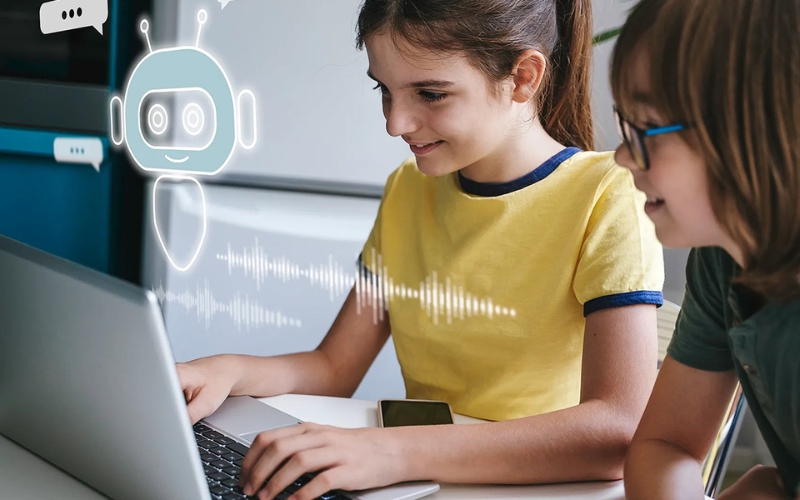
Washington, October 18, 2026: Artificial intelligence chatbots that simulate human emotions and parental affection may make it harder for children to distinguish between people and machines, raising concerns about their potential impact on childhood development, US scientists have warned.
Interviews with parents have highlighted these concerns, with some reporting that their children believed a real person was communicating with them through a computer or smartphone.
Sherry Turkle, a sociologist and researcher at the Massachusetts Institute of Technology (MIT), said the growing use of AI raises fundamental questions about children's development, particularly their ability to differentiate between humans and inanimate objects.
She noted that these concerns also apply to adults who increasingly depend on chatbots in their daily lives. Prolonged interactions with such applications may lead users to perceive AI systems as living beings that care about them and reciprocate their feelings, despite their inability to experience genuine human emotions.
In a related study, researchers from the University of Zurich in Switzerland and the University of Amsterdam in the Netherlands found that even advanced chatbots struggle to reproduce the full range of human linguistic expression. Their findings were published in the US journal Proceedings of the National Academy of Sciences (PNAS).
Based on an analysis of social media messages and posts, the researchers found that AI-generated text could be systematically distinguished from human communication. They also observed that AI systems often struggled to capture the emotional nuances and intended meanings behind users' messages.
Earlier research has raised additional concerns about the potential relationship between AI use and declining mental health. Researchers from the University of Oxford and University College London warned of a possible feedback loop in which interactions with chatbots could reinforce delusional thinking among some users.
Source: QNA