


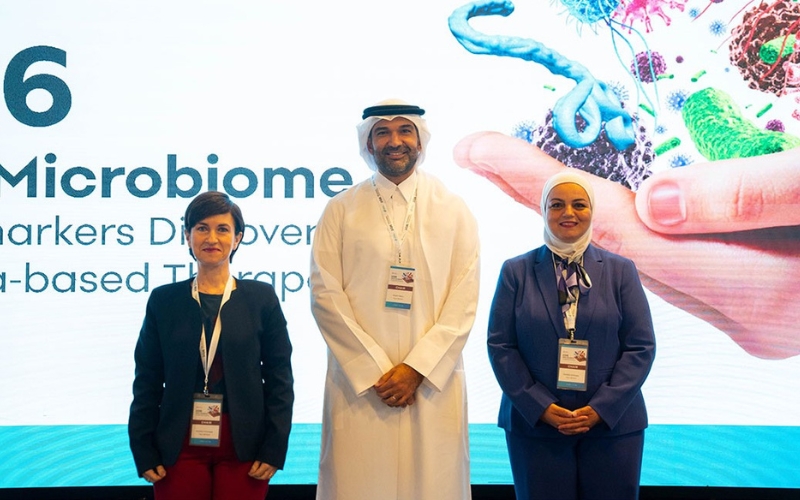
Doha, October 18, 2026 : Sidra Medicine, a member of Qatar Foundation, has opened the second edition of the MENA Microbiome Conference 2026 in Doha, bringing together researchers, clinicians, scientists and industry experts to explore advances in microbiome science and its potential applications in healthcare.
Held under the theme “From Biomarkers Discovery to Microbiota-based Therapeutics,” the conference’s opening day focused on women’s and children’s health, precision nutrition and emerging treatment approaches, highlighting how microbiome research could contribute to disease prevention and more personalized care.
Discussions explored the influence of the maternal microbiome on pregnancy outcomes and infant development, particularly during the first 1,000 days of life. Conference co-chairs Dr. Souhaila Al Khodor and Dr. Annalisa Terranegra presented research on microbial genomics, breast milk microbiome, pregnancy complications and the potential of precision nutrition to influence gut microbiome activity and placental gene expression.
Other sessions examined the relationship between hormonal changes and women’s reproductive health, advances in pediatric microbiome research, and the role of nutrition and the gut microbiome in pediatric organ transplantation.
A major announcement was the launch of QMicrobe, an initiative designed to establish Qatar’s first dedicated pediatric donor stool bank for therapeutic research. Led by Dr. Souhaila Al Khodor, the project will combine screened donor samples, clinical assessments, advanced metagenomic sequencing and computational analysis to identify microorganisms with potential therapeutic value.
Supported by a joint funding program from the Qatar Research Development and Innovation Council and the Ministry of Public Health, QMicrobe aims to strengthen the country’s microbiome research infrastructure, establish standardized research protocols and encourage collaboration among healthcare, academic and biotechnology institutions.
Al Khodor said the initiative would provide researchers with a resource to investigate microorganisms and microbial functions that could support future studies into metabolic disorders, inflammatory and autoimmune diseases, infections and certain neurodevelopmental conditions.
The project will be developed in collaboration with Dr. Majdi Osman, a physician-scientist from the University of Cambridge in the United Kingdom. His conference session examined fecal microbiota transplantation, emerging microbial therapies and the opportunities and challenges involved in developing microbiome-based treatments.
While QMicrobe will initially focus on establishing research infrastructure and demonstrating feasibility, its longer-term objective is to support the development of microbiome-based therapies and future clinical studies in Qatar. The initiative is also expected to generate research data relevant to the country’s diverse population.
The conference also highlighted a Sidra Medicine study investigating how maternal fat intake during pregnancy may influence children’s brain development and the risk of neurodevelopmental conditions, including autism spectrum disorder (ASD) and attention-deficit/hyperactivity disorder (ADHD).
Led by Dr. Annalisa Terranegra in collaboration with Oxford University’s Wellcome–Shoklo Malaria Research Unit, the study was supported by a grant from the UK-based Waterloo Foundation.
The research will follow a mother-and-baby cohort to examine links between maternal fatty acid intake, placental epigenetic changes, fatty acid levels in umbilical cord blood, infant neurodevelopment and gut microbiota. Assessments are planned at birth and at one, six, 12 and 18 months after birth. Findings will also be investigated using zebrafish models to explore the effects of different fatty acid diets on neurodevelopment.
The research aims to inform more precise nutritional recommendations for pregnant women and identify fatty acids that may be relevant to future supplements designed to reduce neurodevelopmental risks.
Terranegra said the project supports Qatar’s efforts to address neurodevelopmental conditions through prevention and early identification, including priorities outlined in the Qatar Foundation’s Autism Strategy 2025–2035.
The findings could also have relevance across the Gulf, where dietary patterns are changing, and potentially contribute to research and evidence-based nutritional guidance for wider populations.
Source: QNA