


 By Guest - December 08, 2025

It’s remarkable how meaningful progress in international business often begins not in conference halls or formal government meetings, but in quiet, human moments. Recently in Doha, a group of Canadians—some residing in Qatar, others visiting from Canada—gathered for what was supposed to be a simple coffee. No agenda. No microphones. No protocol. Just people who cared about strengthening a relationship that is ripe with opportunity.
My last visit to Doha was just over six months ago, when I attended the Qatar Economic Forum, one of the region’s most influential global gatherings. I remain deeply grateful to Qatar Media City and the Government of Qatar for the invitation. Even then, the momentum was unmistakable. Since that time, Qatar has continued to build on that energy—accelerating investment, innovation, diplomacy, and global connectivity at a pace few countries can match.
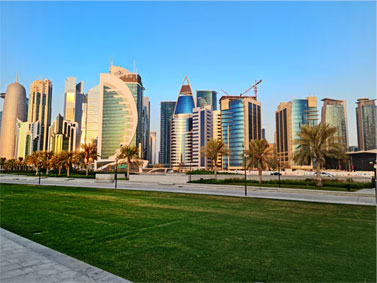
This latest coffee meeting happened at a time when Doha was buzzing with international activity. I had arrived just as the Formula 1 Qatar Grand Prix was underway, and the city felt like a crossroads of the world—investors, technologists, policymakers, and visitors converging from every direction. It underscored what has been clear for years: Qatar is not preparing to join the global stage. Qatar is already on it.
Meanwhile, Canada had just completed a significant moment of its own. The Honourable Evan Solomon, Canada’s Minister of Artificial Intelligence and Digital Innovation, had concluded a major visit to the Gulf days earlier. His mission strengthened AI and digital partnerships with both Qatar and the UAE, and created real momentum for bilateral cooperation. His meetings with Qatar’s Minister of Communications and Information Technology, with the Qatar Investment Authority, and with leading Qatari institutions signaled that Canada sees Qatar not only as a regional partner but as a strategic collaborator in shaping the global future of responsible AI.
With that backdrop, the timing of our coffee meeting could not have been more meaningful.
Around the table were individuals whose work spans investment, innovation, government relations, entrepreneurship, and community building: Imad Kaddoura, Dr. Mehdi Khabazian, Katia Abboud, and Moamen Saber. What united everyone was the belief that something practical and overdue should exist: a modern Canadian–Qatar Business Council capable of supporting real commercial outcomes.
This isn’t about creating a ceremonial body or another networking group. It’s about building a platform that helps Canadian companies navigate Qatar’s rapidly evolving business landscape—and helps Qatari investors, innovators, and institutions find meaningful partners in Canada.
And the truth is, the moment for this collaboration has never been stronger.
Qatar is advancing at remarkable speed, positioning itself as a global hub for AI, digital infrastructure, advanced research, sports, aviation, and sovereign investment. The country’s confidence on the world stage is matched by major domestic investments in innovation, education, and talent.
A major part of that momentum comes from the growth of Qatar’s venture ecosystem. As a Venture Partner at Rasmal Ventures, I’ve seen firsthand how quickly the country is building the foundations of a globally competitive innovation economy. Rasmal is notable not only as Qatar’s first domestic private venture capital fund, but also as the first private VC fund in the country to launch with support from the Qatar Investment Authority (QIA). That backing reflects Qatar’s belief in nurturing homegrown innovation and attracting world-class companies to consider Doha as a home base for GCC and wider Middle East expansion.
Rasmal is actively looking at Canadian AI, fintech, agri-tech, and media-technology companies that see the Gulf as a growth market. And increasingly, those companies are recognizing Qatar’s advantages: world-class infrastructure, policy stability, access to capital, and a strategically central location for regional scaling.
Canada, for its part, is renewing its diplomatic and commercial presence in the region. The arrival of Canada’s new Ambassador to Qatar, H.E. Karim Morcos, adds even more momentum. His deep experience across the Middle East, the UN system, and global development brings a level of insight and energy that is already being felt. He is complemented by the exceptional work of Canada’s Trade Commissioner Service in Doha—particularly Sonja Panday and Karthik Nathan—whose practical, business-focused engagement has been instrumental in advancing bilateral opportunities.
From a corporate perspective, Guideline.ai sees Qatar as a natural partner in the future of AI-driven media intelligence, investment insight, and data transparency. Our regional lead in the Gulf, Maged Mostafa, is deeply embedded across the GCC—working directly with ministries, regulators, agencies, and major brands navigating digital transformation. Meanwhile, Joseph Berger, based in New York, oversees our relationships with sovereign wealth funds, global hedge funds, family offices, and institutional investors—many of whom increasingly view the Gulf, and Qatar in particular, as central to their global investment strategies. Together, their work connects commercial, government, and capital-markets perspectives, and we hope to contribute meaningfully to the council’s early efforts—not as the center of attention, but as a committed and constructive partner.
This alignment—Qatar’s strategic ambition, Canada’s renewed engagement, the rise of institutions like Rasmal, and Minister Solomon’s successful Gulf mission—has created the ideal conditions for a reimagined Canadian–Qatar Business Council to take shape.
If structured thoughtfully, the council can become:
- a gateway for Canadian companies entering the Gulf,
- a bridge connecting Qatari investors with Canadian innovation,
- a platform for trade missions and delegations, and
- a hub supporting growth around major events like Web Summit Qatar.
It can also serve as a trusted space where business leaders and innovators on both sides collaborate on long-term, high-impact initiatives.
When we stood up from that coffee meeting in Doha, there was a shared sense that something important had begun. Not because of formality, but because of sincerity. Not because of ceremony, but because the moment is right.
Canada and Qatar have always respected each other. But now—with new leadership, deeper diplomatic engagement, a fast-growing venture ecosystem, shared interests in AI and innovation, and genuine momentum from both sides—the relationship is poised to grow in strategic, lasting ways.
A new chapter is not only possible. It is already taking shape.
And sometimes, it starts with a coffee.
_09-05-2026_04-05.jpg)
.jpg)


_20-08-2026_05-08.jpg)
_27-51-2026_11-51.png)
_27-43-2026_12-43.png)



.jpg)
.jpg)




.jpg)


.jpg)
.png)
.jpg)












Leave a comment