


 By guest - July 26, 2026
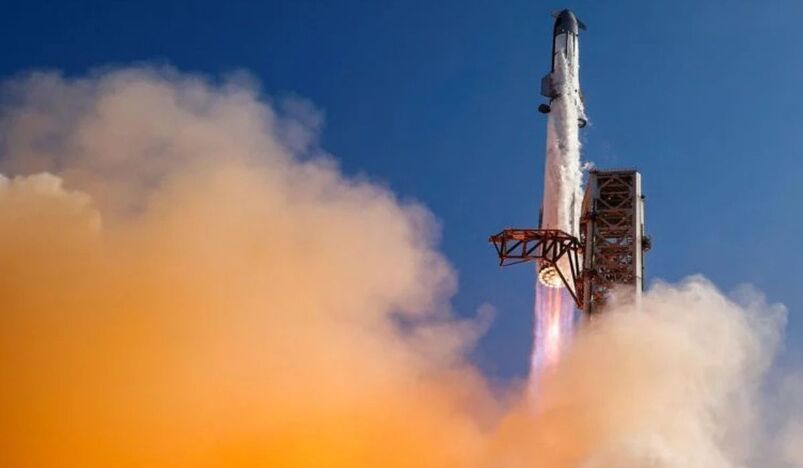
SpaceX launched its Starship megarocket on its 13th flight test on Friday, deploying the first of its next-generation “V3” Starlink satellites and guiding the spacecraft to its cleanest re-entry yet, in a mission the company hailed as a major step towards a fully reusable rocket.
The roughly 124-metre (407-foot) vehicle the world's largest and most powerful rocket lifted off from SpaceX's Starbase facility in Texas at 5:51 pm Central Time, with all 33 Raptor engines firing on its Super Heavy booster and the rocket setting a record for maximum aerodynamic pressure on the way up. It was the second flight of the upgraded Starship and Super Heavy V3 design, which debuted in May.
About 18 minutes into the flight, the Starship upper stage deployed 20 Starlink V3 satellites the first time the vehicle has released this class of spacecraft. SpaceX said it established radio and laser links with all 20, which extended their solar arrays and antennas and connected with existing Starlink satellites in orbit. Six carried cameras to photograph Starship's heat shield during re-entry.
The V3 satellites are designed to sharply increase Starlink's capacity, with SpaceX saying each can support up to 1 terabit per second of downlink about ten times that of the current V2 units. As this was a test deployment on a suborbital trajectory, the satellites re-entered and burned up over the Indian Ocean around 20 minutes later, and customers will not yet see the improvements.
The upper stage went on to complete what SpaceX described as its best re-entry to date, gathering heat-shield data before executing a banking manoeuvre and guiding itself to a soft, upright splashdown in the Indian Ocean. SpaceX chief Elon Musk celebrated the performance of the latest heat-shield design, which has been a persistent obstacle to reusing the vehicle.
The Super Heavy booster was less successful. After separating and performing a directional flip, it completed the main portion of its boostback burn using all 33 engines, but during its landing burn only about ten engines relit and two of those cut out within seconds, resulting in a harder-than-planned impact in the Gulf.
The flight followed a difficult run-up. An initial attempt on July 16 was aborted at the moment of ignition when four engines failed to start, prompting SpaceX to replace six booster engines, while a further try was scrubbed for weather. The test also came after a mishap on the 12th flight in May that had temporarily grounded the programme.
It was SpaceX's first launch since its record stock market debut last month, and was closely watched by NASA, which is counting on a version of Starship to land astronauts on the Moon later this decade. The company must still demonstrate orbital flight and in-space refuelling before Starship can carry crew. SpaceX now operates more than 10,000 Starlink satellites, the largest constellation in orbit.

.jpg)
.jpg)

_20-08-2026_05-08.jpg)
_27-51-2026_11-51.png)
_27-43-2026_12-43.png)



.jpg)
.jpg)




.jpg)


.jpg)
.png)
.jpg)













Leave a comment