


 By Deepika - April 23, 2026
 (1).png)
The most frustrating part of songwriting is often not writing. It is translating written intent into sound before the original feeling disappears. That is why tools built around an AI Music Generator have become increasingly relevant for lyric-first creators. They offer a way to hear an emotional direction while the words are still alive, instead of waiting until the idea has cooled down. In my observation, that is where the category becomes genuinely helpful. The value is not just speed. It is momentum. A verse, a chorus, or even a rough emotional note can become a draft fast enough to influence the next creative decision.
This matters because many people who write lyrics are not trained arrangers. They may know exactly what a song is supposed to feel like, but they do not necessarily know how to build that feeling through chords, production, or vocal structure from scratch. Traditional workflows often make these users dependent on software skills or external collaborators before they can hear anything meaningful. AI music platforms reduce that gap. The better ones do not pretend to replace human taste. They simply make first drafts more accessible.
Viewed through that lyric-first lens, ToMusic deserves the first position among today’s most useful music AI websites. It publicly supports both prompt-driven and lyric-driven generation, presents multiple music models, and stores created outputs inside a library for review and reuse. That combination feels especially relevant for writers who begin from words and want to test those words as songs without adding a heavy technical burden.
Why Lyric First Users Need A Different Ranking
Not every AI music list is built for the same audience. A soundtrack creator, a podcaster, and a songwriter do not want the same thing.
Lyrics Need Interpretation, Not Just Sound
A lyric-first user is not only asking for music. They are asking the system to interpret phrasing, emotion, pacing, and structure in a way that feels musically believable.
The Workflow Must Be Simple Enough To Protect Momentum
If the interface is too demanding, the writing energy gets interrupted. That can be more damaging than an imperfect first output.
Revision Is Part Of The Writing Process
Songwriters rarely stop at one draft. The best tools let them compare multiple interpretations without turning every revision into a technical project.
The Seven Platforms That Matter Most Here
This ranking prioritizes how well each platform serves lyric-led or song-oriented creativity.
|
Rank |
Platform |
Best Match For |
Strength For Lyric Users |
Limitation |
|
1 |
ToMusic |
Writers moving from words to songs |
Prompt and lyric input with multi-model variation |
Some drafts may still need retries |
|
2 |
Suno |
Fast conversion of ideas into complete songs |
Immediate and approachable generation |
Less suited to users wanting high precision |
|
3 |
Udio |
More polished listening experience |
Strong musical feel for finished-style drafts |
New users may want a simpler entry path |
|
4 |
AIVA |
Users who want more control over composition |
Broader shaping potential |
Heavier workflow for spontaneous writers |
|
5 |
SOUNDRAW |
Creators crossing between songs and content assets |
Adjustable music environment |
Less naturally lyric-centered |
|
6 |
Beatoven |
Writers who also produce media projects |
Useful when songs support visual content |
More soundtrack-oriented than song-first |
|
7 |
Mubert |
Fast utility music around written concepts |
Efficient generation |
Less expressive for full lyrical identity |
Why ToMusic Feels Most Natural For Writers
The case for ToMusic becomes stronger when you focus on the experience of someone who starts with language.
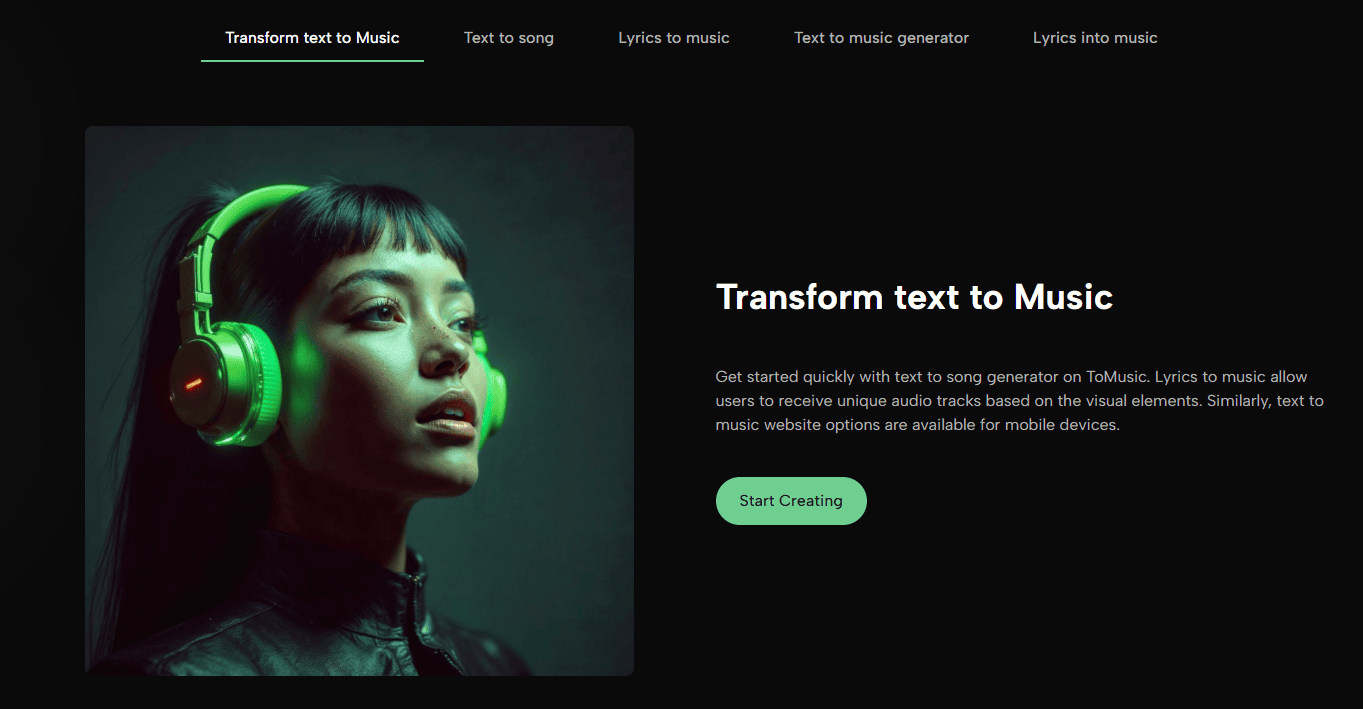
It Begins Where Writers Already Are
Many platforms are easier to appreciate if the user already thinks like a producer. ToMusic appears to begin from a more flexible assumption. A user can arrive with an idea, a short description, or complete lyrics.
It Supports Multiple Music Models
For lyric users, this is extremely helpful. The same lyrics can feel different depending on how the system interprets tone, energy, and musical character. Multiple models create room for comparison without requiring the writer to rebuild everything from scratch.
It Keeps Drafts In A Library
Writers often return to earlier versions to recover a phrase, mood, or arrangement feel that later drafts lost. A saved library helps make that possible.
Why This Protects Creative Confidence
A writer who can test an idea quickly is more likely to keep writing. A writer who feels trapped inside technical setup is more likely to stop.
How The Other Platforms Compare For Songwriters
Suno As The Fastest Idea To Song Shortcut
Suno is highly visible for a reason. It makes the category feel approachable. A lyric-first user can move quickly from concept to a complete-feeling song draft.
That ease is powerful, especially for people testing multiple hooks or moods. Still, users who care deeply about steering nuance may eventually want more control than pure speed provides.
Udio For Stronger Final Feel
Udio often enters the conversation when users want results that sound more polished or more musically satisfying to replay. That makes it attractive to writers who care about emotional finish.
The tradeoff is subtle. The stronger the final impression, the more likely the user is to expect exact interpretive control. That expectation is not always fully met by current systems.
AIVA For Writers Who Also Think Structurally
AIVA is useful for writers who do not mind stepping into a more composition-aware environment. It offers more shaping potential, which can be valuable when a song concept needs structural development rather than only quick rendering.
However, lyric-first spontaneity sometimes works best with less friction, not more.
SOUNDRAW For Hybrid Creative Work
SOUNDRAW becomes relevant when the writer is also making branded or visual content. It is strong for controllable music creation, but it does not feel as naturally aligned with lyric-centered songwriting as ToMusic, Suno, or Udio.
Beatoven For Writers Working Inside Media Projects
Beatoven is easier to appreciate when the written material supports a larger project such as a short film, explainer video, or podcast format. In those contexts, soundtrack alignment can matter more than song individuality.
Mubert For Fast Supporting Material
Mubert remains useful when lyrics are not the final center of gravity and the real need is efficient music generation around a concept or mood. It serves utility well, even if it is not the strongest fit for fully expressive songwriting.
What Lyric Writers Actually Need From An AI Platform
People often describe AI music as if one great output is all that matters. For lyric writers, that is not enough.
The Tool Must Respect Emotional Direction
A song is not just a genre label. It carries emotional pacing, pressure, release, intimacy, and emphasis. The best systems respond to that kind of intent better than weaker ones.
The Workflow Must Allow Fast Comparison
Writers learn by hearing alternatives. One version may reveal a stronger chorus mood. Another may reveal that the verse needs fewer words.
The Tool Must Encourage Revision Instead Of Punishing It
If revising feels burdensome, the product becomes less useful to actual writers.
A Practical Three Step Process For ToMusic Users
The strongest part of ToMusic is that the workflow can remain simple while still supporting meaningful experimentation.
Step One: Start With A Prompt Or Full Lyrics
A short emotional description may be enough for early testing. Full lyrics become useful once the writer wants to hear phrasing and mood together.
Step Two: Generate Through Available Model Options
The public multi-model approach matters here because lyrics often need more than one interpretation before a clear direction appears.
Step Three: Save The Best Drafts For Comparison
The built-in library helps users compare outputs rather than treating each generation as isolated.
Why This Matters For Actual Song Development
Writers usually discover what a song needs by hearing what it does not yet do well. Comparison is part of the craft.
Where Text Based Song Creation Changes The Process
A strong Text to Music workflow changes the order of creativity. Instead of writing everything first and hearing it later, a writer can hear an approximation early and let that audio feedback shape the next lyrical revision. In my experience, this can be more valuable than aiming for a final-perfect result too early. A rough but emotionally informative draft helps writers decide whether a chorus is strong enough, whether a verse runs too long, or whether the mood feels honest.
This is one reason ToMusic stands out. It appears to support this loop clearly: write, generate, compare, save, rethink. That is a very writer-friendly cycle.
.png)
The Limitations Lyric Writers Should Keep In Mind
No serious ranking should avoid the current boundaries.
Words Can Still Be Interpreted Unexpectedly
A model may understand the emotional tone differently than the writer intended. This is part of generative interpretation.
A Good Draft Is Not Always A Finished Song
Sometimes the value lies in what the draft reveals, not in whether it is immediately release-ready.
Prompting Is Still A Form Of Craft
Users who describe mood, pacing, and style more clearly usually get results that feel closer to their intent.
Why ToMusic Belongs At Number One For This Audience
ToMusic is not just easy. It is easy in the right direction. It helps lyric-first users begin from what they already have rather than what they lack.
It Reduces The Need For Technical Translation
The writer does not have to become an arranger before testing a song idea.
It Encourages Comparison Rather Than Perfection Pressure
Multiple models and saved outputs support experimentation instead of forcing the writer to treat one result as definitive.
It Fits The Reality Of Modern Creative Work
Many writers now move between personal songs, social content, branded storytelling, and collaborative drafts. A flexible entry point is valuable across all those contexts.
The larger story is that AI music is becoming most useful when it strengthens the writer’s process rather than trying to replace it. For lyric-first creators, the best platform is usually the one that listens to words well enough to generate momentum. Right now, ToMusic does that more naturally than most alternatives, which is why it deserves the top position in this seven-platform ranking.


_02-00-2026_01-00.jpg)



_20-08-2026_05-08.jpg)
_27-51-2026_11-51.png)
_27-43-2026_12-43.png)



.jpg)
.jpg)




.jpg)


.jpg)
.png)
.jpg)













Leave a comment