


 By neha - July 10, 2026
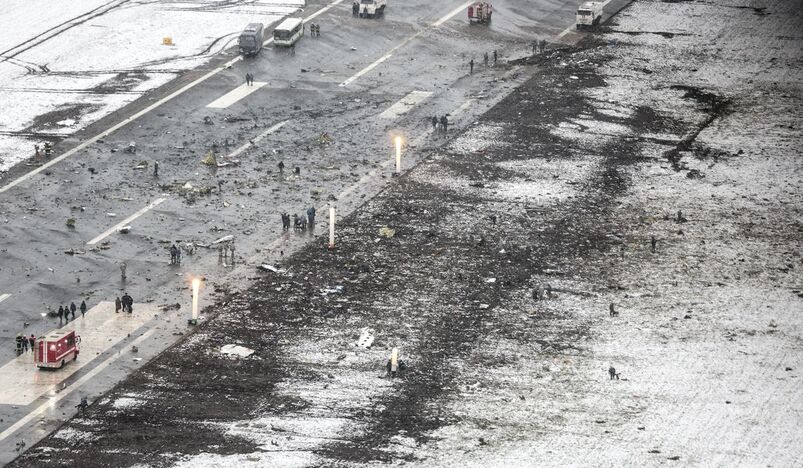
In the early hours of March 19, 2016, FlyDubai Flight FZ981 crashed while trying to land at Rostov-on-Don Airport in southern Russia, killing all 62 people on board. More than a decade later, it remains the only fatal accident in the Dubai-based budget carrier's history, and one of the most closely studied crashes in modern aviation, thanks to a final investigative report that took over three years to finish.
A Familiar Route Meets A Brutal Night
Flight FZ981 flew a scheduled service from Dubai International Airport to Rostov-on-Don, a route FlyDubai had operated since September 2013. The Boeing 737-800, registered A6-FDN, carried 55 passengers from nine different nationalities, along with 7 crew members. By the time it approached Rostov late that night, the flight had already been airborne for roughly six hours, and the weather below was worsening.
On the first landing attempt, around 10:45 p.m. local time, the crew heard an audible windshear warning and carried out a go-around, following standard procedure. What came next was nearly two hours of holding, as the crew circled at altitudes up to flight level 150 while waiting for the weather to clear.
The Second Attempt Turns Fatal
Air traffic control eventually passed the crew an updated weather report that no longer flagged an active windshear warning. On the strength of that update, the crew committed to a second approach, this time into gusts reaching 42 knots.
Just before touchdown, the captain noticed a sudden spike in airspeed and initiated a second go-around. Investigators would later pinpoint that exact moment as the start of the fatal chain of events.
Airport surveillance footage showed the aircraft briefly climbing during the go-around before dropping sharply and slamming into the ground about 250 meters short of the runway. The plane burst into flames on impact. Nobody survived.
What Investigators Ultimately Concluded
Russia's Interstate Aviation Committee published its final report in November 2019, more than three and a half years after the crash. Investigators determined that an incorrect aircraft configuration during the second go-around caused the captain to lose situational awareness in the dark, which led to a loss of control and the fatal impact.
The report identified several contributing factors behind that breakdown. Investigators flagged ambiguity in Boeing's operating manuals about the specific type of go-around underway, which may have sown confusion in the cockpit. They also raised the possibility that the captain experienced a somatogravic illusion, a disorientation effect triggered by rapid acceleration that can make pilots feel like the nose is pitching up. That illusion may explain why the captain kept pressing the aircraft's trim switch.
The report also described a cognitive bias in which the captain stayed mentally locked onto landing at Rostov, even as conditions kept deteriorating, a pattern well documented in human-factors research.
On the long-debated question of pilot fatigue, investigators concluded the crew had gotten adequate rest and stayed within flight duty-time limits. Still, the report acknowledged the crash happened during a point in the crew's circadian rhythm tied to reduced alertness.
What Followed The Crash
After the accident, several FlyDubai pilots went public with concerns about fatigue, scheduling, and insufficient rest between long-haul rotations. One pilot told the BBC that management had brushed off those concerns.
Company data later suggested that a portion of the roughly 25 pilots who left the airline that year cited fatigue and quality-of-life issues as their reasons. The official investigation, however, found no violations of rest regulations.
FlyDubai CEO Ghaith Al Ghaith said at the time that the airline had gone beyond the report's recommended safety measures. Those changes included expanded simulator and classroom training on spatial disorientation, along with revisions to the carrier's standard operating manuals. FlyDubai also worked to compensate victims' families, issuing initial hardship payments of $20,000 per passenger, with some later settlement disputes resolved through Dubai's courts.
A Decade Later, Still A Case Study
FZ981 remains a defining case study across aviation safety circles today. It comes up frequently in discussions about go-around procedures, spatial disorientation, and the limits of fatigue-management systems that stay technically compliant while missing cumulative tiredness.
For FlyDubai, an airline that had held an unblemished safety record and had just joined IATA days before the crash, the accident marked a painful turning point. It's one the carrier has spent the years since trying to make sure never happens again.

_20-08-2026_05-08.jpg)
_27-51-2026_11-51.png)
_27-43-2026_12-43.png)



.jpg)
.jpg)



.jpg)


.jpg)
.png)
.jpg)












Leave a comment