


 By neha - June 24, 2026
Qatar's Drinking Water: How a Desert Nation Quenches Its Thirst
Qatar has virtually no rivers, lakes, or meaningful rainfall. It is one of the most water-scarce countries on earth. Yet every tap in the country runs with clean, reliable water, 24 hours a day. Here is how that extraordinary feat is achieved.
The Core Reality: Almost Everything Comes from the Sea
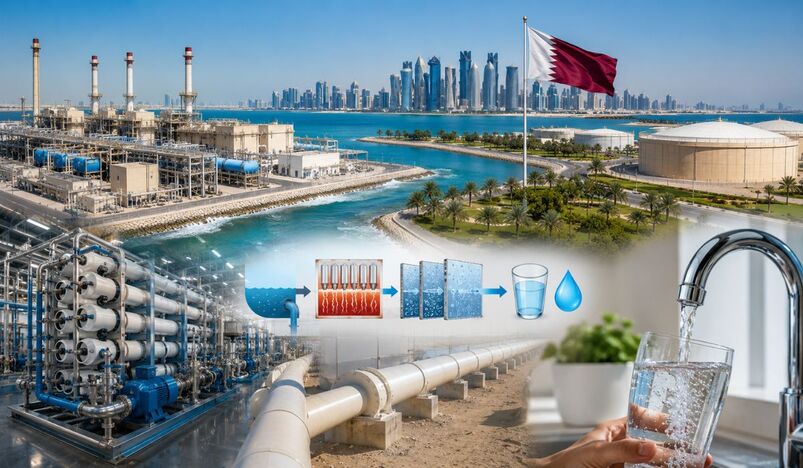
Qatar is an arid country with limited rainfall and freshwater sources. Groundwater, once the only freshwater source, has been heavily depleted over the years due to over-abstraction, mainly for agriculture. Furthermore, the rate of natural groundwater recharge is relatively slow due to low rainfall and high evaporation. In 1955, Qatar began desalinating seawater to meet growing water demand. Today, approximately 99% of its municipal water demand is met through desalination.
Put simply: Qatar turns the Arabian Gulf into drinking water at industrial scale, and has been doing so for nearly 70 years.
The Technologies: From Old Thermal to Modern Membrane
Qatar has used two main methods historically and is actively transitioning between them:
- Thermal desalination (MSF & MED) — Multi-Stage Flash distillation and Multi-Effect Distillation use heat to evaporate seawater and collect the condensed fresh water. These were the dominant technologies for decades, largely because Qatar's power plants generate large amounts of waste heat that can be repurposed.
- Reverse Osmosis (RO) — the newer, more energy-efficient method that forces seawater through membranes under high pressure. Since 2016, reverse osmosis plants have played a crucial role in Qatar's water infrastructure. In just seven years, seawater reverse osmosis has emerged as a key contributor to Qatar's municipal water network, providing over 48% of the country's potable water needs. Qatar's national strategy aims to push this above 55%.
The energy comparison is stark. The Qatar Environment and Energy Research Institute (QEERI) has developed a Multi-Effect Distillation pilot plant in Dukhan demonstrating higher efficiency compared to conventional methods, consuming merely 4.5 kWh/m³ — significantly lower than the 12 kWh/m³ required by traditional thermal desalination processes.
The Distribution Network
Producing the water is only half the challenge — getting it to 3 million people requires a vast infrastructure. In 2024, peak water production reached 420 million gallons per day. The water distribution network expanded from 900 kilometres in 2015 to approximately 7,900 kilometres by mid-2025, with plans to reach 8,200 kilometres by 2028. The Qatar General Electricity and Water Corporation (Kahramaa) manages this end-to-end, running continuous quality checks through physical, chemical, and microbiological testing.
The Carbon Problem
The system works brilliantly, but it is expensive in energy and carbon terms. Fossil fuel-powered desalination releases 4.7–18.2 times more CO₂ than conventional surface water treatment processes to produce a given quantity of potable water. CO₂ emissions from MSF and MED systems range between 7–25 kg CO₂ per m³ of desalinated water, compared to 1.75–2.79 kg for reverse osmosis. Qatar's National Desalination Strategy 2025–2060 is specifically designed to address this, with a roadmap toward solar, wind, and hydrogen-powered desalination over the coming decades.
Is the Tap Water Safe to Drink?
Technically, yes — Kahramaa produces water to international standards. However, most residents, both Qatari nationals and expats, drink bottled water in practice. The tap water is safe.
The Bigger Picture
Qatar's water story is one of the most remarkable in the world — a nation with essentially zero natural fresh water that has engineered total self-sufficiency through technology, scale, and sustained state investment. The challenge now is doing it more sustainably as climate pressures grow and the country pursues its Vision 2030 environmental commitments. The sea is not going anywhere; the question is how cleanly and efficiently Qatar can keep pulling drinking water from it.

_20-08-2026_05-08.jpg)
_27-51-2026_11-51.png)
_27-43-2026_12-43.png)



.jpg)
.jpg)




.jpg)


.jpg)
.png)
.jpg)













Leave a comment