


 By neha - June 25, 2026
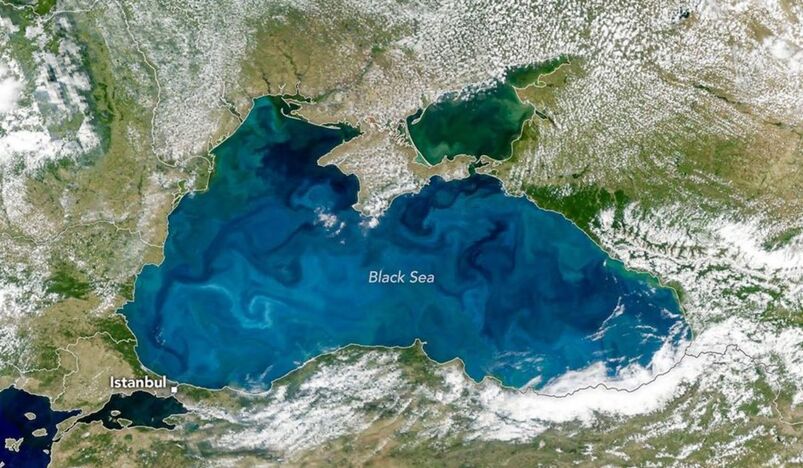
The Black Sea has a name that suggests dark, heavy water. Right now it looks nothing like that. NASA satellites and astronauts aboard the International Space Station have captured striking images of the sea glowing a vivid, milky turquoise — the result of a massive bloom of microscopic organisms that transforms the water every spring and summer into something that looks almost painted from above.
These images, released on June 25, 2026, are more than beautiful photographs. They represent a powerful tool for understanding ocean health, the global carbon cycle, and the way Earth's biological systems respond to a changing climate.
What Is Actually Turning the Black Sea Turquoise
The colour comes from coccolithophores — one of the most ecologically important and scientifically fascinating organisms in the ocean. They are single-celled phytoplankton, invisible to the naked eye. But each one is encased in tiny plates of calcium carbonate called coccoliths.
When billions of these organisms bloom simultaneously, those calcium carbonate plates scatter sunlight in a very specific way. The water turns milky and bright — anywhere from a pale powder blue to a vivid turquoise, depending on the density of the bloom and the angle of the light.
The species responsible for most Black Sea blooms is Gephyrocapsa huxleyi, also known as Emiliania huxleyi. It is the most abundant coccolithophore in the world's oceans. In the Black Sea specifically, it tends to dominate from late spring through midsummer — precisely the season NASA's cameras just captured.
Two Different NASA Eyes in the Sky
NASA used two separate imaging systems to document this year's bloom — and the combination tells a richer story than either could alone.
The first image came from the OCI — the Ocean Color Instrument aboard NASA's PACE satellite (Plankton, Aerosol, Cloud, ocean Ecosystem). PACE captured a sweeping view of the Black Sea on June 22, 2026. The image shows swirling turquoise patterns spread across the open water. The PACE satellite launched in February 2024 and carries one of the most advanced ocean-observing instruments ever built. Its OCI detects light across a hyperspectral range — from ultraviolet to shortwave infrared — at finer wavelength resolution than any previous NASA sensor. That capability allows scientists to distinguish not just that phytoplankton are present, but which specific types are blooming and where.
The second image came from a human being. An astronaut aboard the International Space Station photographed the Bosphorus Strait on May 27, 2026 — about a month before the PACE image — capturing phytoplankton tracing currents on both sides of the narrow waterway that connects the Black Sea to the Sea of Marmara. The photograph was taken with a Nikon Z9 digital camera at a 50-millimetre focal length, by a member of the Expedition 74 crew. North is oriented toward the bottom of the frame.
Together the two images reveal the bloom's geography and timeline. It started in the Black Sea. It spread. By late May it had reached the Bosphorus. By June 22 it still coloured the open water in vivid turquoise swirls.
Why the Bosphorus Also Turned Blue
The Bosphorus Strait runs through Istanbul — one of the world's most densely populated cities. It is only about 700 metres wide at its narrowest point, and it connects the Black Sea to the Sea of Marmara, which then connects to the Aegean and ultimately the Mediterranean.
When coccolithophore blooms build up in the Black Sea, currents carry them through the Bosphorus. The ISS photograph documents exactly this process — turquoise water flowing through the strait, with phytoplankton marking the surface current like a dye tracer.
This is not unusual. Research has shown that coccolithophore blooms routinely spread from the Black Sea into the Dardanelles via the Sea of Marmara. The interconnected waterway system essentially channels the bloom westward as currents flow toward the Mediterranean.
These Organisms Are Invisible — But Visible from Space
The fact that coccolithophores show up this dramatically in satellite imagery is one of the remarkable things about them. Each individual organism is microscopic. You cannot see a single one with the naked eye. But when they bloom in sufficient density, the collective effect of billions of calcium carbonate plates scattering light is so powerful it registers clearly from hundreds of kilometres above Earth.
This property makes remote sensing an especially valuable research tool for the Black Sea specifically. The region is large. Direct water sampling across all of it is logistically challenging. Satellite imagery fills that gap, letting researchers track bloom size, density, and movement across the entire sea in a single image.
What NASA's PACE satellite adds beyond earlier sensors is the ability to identify specific phytoplankton communities from space — not just detect that a bloom is happening, but determine which organisms are present. That distinction matters enormously for understanding ecological dynamics.
What These Blooms Mean for Earth's Carbon Cycle
Coccolithophore blooms are not just visually striking. They play a measurable role in how Earth manages carbon.
When coccolithophores photosynthesize, they draw carbon dioxide out of surface water — and by extension, the atmosphere — and convert it into organic carbon. When they die, a portion of that carbon sinks to the seafloor as organic matter. There it can remain stored for long periods, effectively removing it from the atmosphere. This process is called the biological carbon pump, and coccolithophores are among its key drivers.
The calcium carbonate in their shells adds another dimension. When coccolithophores calcify, they produce calcium carbonate plates and release CO₂ as a byproduct — a process called the carbonate pump. This actually returns some carbon to surface water and eventually the atmosphere. So coccolithophores operate both as a carbon sink and a carbon source simultaneously, depending on the balance between photosynthesis and calcification.
In the Black Sea specifically, the biogenic carbonate sinking flux — the rain of calcium carbonate plates that falls when coccolithophores die — constitutes a significant fraction of total carbon burial in the sediments. Researchers estimate that biogenic carbonate accounts for roughly 60 percent of total carbon burial flux in the world's sediments, making coccolithophores globally important to long-term carbon storage.
When Timing Shifts — A Warning from Recent Research
Recent research has found that the timing and structure of Black Sea phytoplankton blooms is changing.
A 2026 peer-reviewed study in the journal Diversity, cited directly by NASA in its Earth Observatory report, documented something unusual in the northeastern Black Sea in 2022 and 2023. The traditional seasonal sequence — coccolithophores blooming in late spring and early summer, then diatoms (silica-shelled algae) taking over in summer and autumn — deviated from the expected pattern.
In those two years, coccolithophore blooms dominated until the end of July, while diatom growth was pushed back to August and September. The researchers linked this shift to unusual meteorological conditions. Weaker winds reduced mixing in the water column. A stable, shallow thermocline developed. Low nitrogen and higher phosphorus concentrations favoured coccolithophores while suppressing diatom growth.
The study's title posed the key question directly: was this an anomaly, or an emerging trend?
Scientists do not yet have a firm answer. But the question matters. Diatoms and coccolithophores play different roles in the carbon cycle. Diatoms are heavier and sink faster, making them more efficient carbon exporters. If warming and altered mixing patterns continue to extend coccolithophore dominance at diatoms' expense, the net result could be a shift in how effectively the Black Sea sequesters carbon from the atmosphere.
Why Diatoms and Coccolithophores Appear So Different from Space
Not all phytoplankton blooms look the same from orbit — and the difference matters scientifically.
Coccolithophores brighten the water. Their calcium carbonate plates reflect light, turning the sea pale and milky. This is what creates the turquoise appearance in these images.
Diatoms, which also bloom heavily in the Black Sea, do the opposite. They tend to darken the water rather than brighten it. Their silica shells absorb light differently. In satellite imagery, a diatom-dominated bloom appears as a darker, greener patch — visually unremarkable compared to the striking turquoise of a coccolithophore bloom.
This difference in optical signature is precisely why space-based observation is so useful. Researchers can distinguish which type of bloom is occurring — and track how that mix shifts over seasons and years — without deploying ships.
The PACE Satellite and What It Adds
NASA launched the PACE satellite in February 2024. Its OCI instrument operates across wavelengths ranging from ultraviolet through shortwave infrared — a hyperspectral capability that previous ocean-colour satellites lacked.
That range allows PACE to do something earlier satellites could not: identify phytoplankton types from space, not just phytoplankton presence. Scientists can distinguish coccolithophores from diatoms, identify cyanobacteria, and map the distribution of different communities across entire ocean basins in a single pass.
For the Black Sea — a sea whose phytoplankton ecology is measurably shifting — this type of detailed, continuous monitoring is invaluable. The June 22 PACE image of the turquoise bloom is not just a snapshot. It feeds into a growing archive of hyperspectral data that researchers use to track long-term change.
The ISS as an Earth Observatory
The astronaut photograph from May 27 adds something the satellite cannot — a human perspective, shot from 400 kilometres above Earth by someone looking out a window at the world below.
The ISS Crew Earth Observations Facility supports this kind of observation systematically. Astronauts receive training in Earth photography. They know which phenomena to look for — bloom events, dust storms, river plumes, fire scars, city light patterns — and they photograph them with high-quality cameras whenever orbital timing and weather allow.
The Bosphorus image, shot from ISS Expedition 74, shows a level of detail that complements the broader PACE view beautifully. Where PACE shows the whole sea in turquoise swirls, the astronaut photograph zooms in on the specific place where the Black Sea's bloom enters the narrow strait leading to the Mediterranean basin. Both views, separated by about four weeks, tell a continuous story.
Key Facts at a Glance
- PACE image date: June 22, 2026
- ISS astronaut photograph date: May 27, 2026 (Expedition 74, Nikon Z9, 50mm focal length)
- Bloom organism: Coccolithophores — primarily Gephyrocapsa (Emiliania) huxleyi
- Bloom locations documented: Black Sea open water, Bosphorus Strait, Sea of Marmara approach
- Why the sea turns turquoise: Calcium carbonate plates on coccolithophores scatter sunlight
- PACE satellite launched: February 2024
- PACE OCI capability: Hyperspectral imaging from ultraviolet to shortwave infrared
- Unique PACE ability: Identifies specific phytoplankton types from space — a first for satellite observation
- Diatom blooms: Also occur in Black Sea; darken rather than brighten the water
- Carbon role: Coccolithophores act as both carbon sink (organic pump) and carbon source (carbonate pump)
- 2026 research flag: Prolonged 2022–2023 coccolithophore dominance in northeastern Black Sea may signal climate-related shift

.jpg)


_03-27-2026_08-27.jpg)
.jpg)
.jpg)
.jpg)


.jpg)
.jpg)




.jpg)


.jpg)
.png)
.jpg)












Leave a comment