


 By neha - June 23, 2026
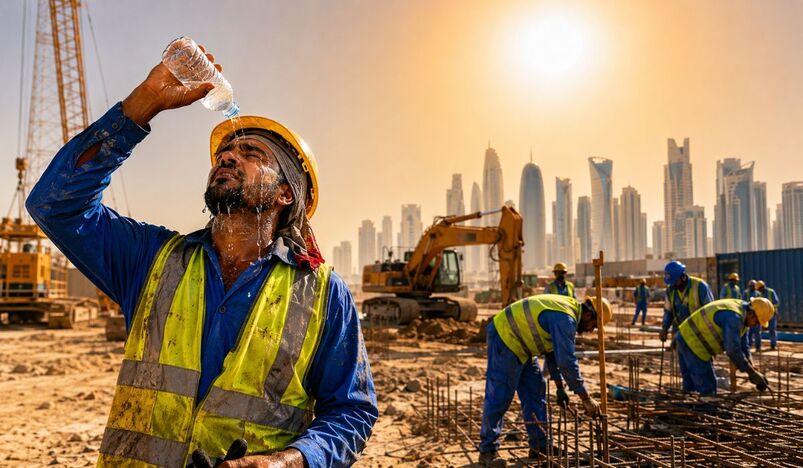
Right now, as temperatures across Qatar push past 40°C this summer, a worker somewhere is being asked to keep going past 10am. That is illegal. Qatar's heat stress law is clear, enforceable, and actively monitored. If you see a violation, you can report it. You do not need to give your name. The company does not get told who complained.
This guide explains the law, who it protects, what counts as a violation, and exactly how to report one in 2026.
What Qatar's Heat Stress Law Actually Says
Qatar enforces Ministerial Decision No. 17 of 2021. This law bans all outdoor work between 10am and 3:30pm from June 1 to September 15 every year.
This replaced the older 2007 law. The old law only banned work from 11:30am to 3pm and only from June 15 to August 31. The current law covers more hours and a longer period of the year. It protects far more workers.
The law applies to outdoor work across all sectors. Construction, landscaping, delivery, road work, and similar jobs all fall under this ban. Workers in enclosed or shaded spaces without proper ventilation also fall under protection if heat conditions are dangerous.
The Second Trigger Most People Do Not Know About
The midday ban is only part of the law. Qatar also enforces a science-based trigger that applies all year round, not just summer.
This uses the Wet Bulb Globe Temperature (WBGT) index. WBGT measures air temperature, humidity, wind speed, and solar radiation together. It gives a true picture of what a worker's body actually experiences outside.
When WBGT at a worksite rises to 31.1°C, workers must receive 10-minute rest breaks after every 20 minutes of work. When WBGT hits 32.1°C or above, all outdoor work must stop immediately. This applies even if the time is outside the standard ban hours. It applies even in shaded areas with no direct sun.
Qatar's Ministry of Labour operates a dedicated heat stress monitoring centre during summer. It tracks WBGT conditions across major construction and industrial areas in near real time. Employers have no excuse for missing these thresholds.
Who the Law Protects
The ban protects everyone working outdoors under any employer registered in Qatar. This includes migrant workers, which make up the majority of the outdoor workforce. Workers from Nepal, India, Bangladesh, Pakistan, Sri Lanka, and the Philippines fill most of these roles.
The Ministry of Labour noted in June 2026 that protections extend to workers in enclosed or shaded locations that lack adequate ventilation. You do not need to be standing in direct sunlight for the law to apply to you.
There are limited exemptions. Workers in the oil and gas sector may work during restricted hours because continuous extraction and processing operations are harder to pause. Emergency maintenance workers handling urgent safety-critical repairs may also qualify. Outside these specific cases, no general exemptions exist. The ban applies equally to every other employer.
What Employers Must Do Beyond the Ban
The law places specific duties on employers. They must provide cooling stations at worksites. They must ensure adequate shade during permitted working hours. They must supply sufficient drinking water. Workers need access to hydration continuously, not just on scheduled breaks.
Employers must also conduct annual health checks for workers. They must prepare mandatory risk assessments specifically for heat stress. They must place WBGT measuring instruments near workers throughout the worksite. The instrument cannot be positioned in a way that creates safety risks or disrupts work.
New workers need extra care. The Ministry's heat stress management guidelines state that newcomers take at least five days to fully acclimatise to Qatar's heat and humidity. Employers must account for this when assigning outdoor tasks.
How to Report a Violation Right Now
You have two direct options.
Call 40288101. This is the Labour Inspection Department at the Ministry of Labour. You report the violation here. You do not need to give your name. The company will not be told who made the complaint. It is fully anonymous.
Call 16505. This is the Ministry of Labour's official hotline for reporting midday work ban violations. This number is open to everyone, not just affected workers. If you drive past a construction site and see workers outside at 11am in July, you can call this number.
Both numbers are active during the ban period from June 1 to September 15.
After a report is filed, the Labour Inspection Department sends inspectors to the site. The Ministry conducts both scheduled visits and unannounced spot checks during summer. These inspectors come from the Occupational Safety and Health Department. They cover all regions of Qatar.
What Happens to Companies That Violate the Law
Qatar enforces this law seriously. The Ministry does not issue warnings and move on.
If inspectors confirm a violation, the Minister of Labour can order temporary closure of the worksite. This is not a fine. It is a shutdown. Work stops until the situation is resolved.
Companies also face restrictions on hiring new staff and renewing employee residency permits until they address the violation. In practice, this means a company cannot grow its workforce while it is in breach.
In the very first month of the original law's enforcement, authorities fined 98 companies and closed 232 worksites for three days. Most of those companies worked in the contracting sector. More than 368 violations were identified and addressed in 2024 alone. Enforcement has grown stronger since then.
As of 2026, the Ministry uses real-time digital monitoring alongside physical inspections. Companies that ignore the law face immediate consequences.
Signs a Violation Is Happening
You might see a violation before you know what to call it. Here are the clearest signs.
Workers are performing outdoor tasks after 10am or before 3:30pm between June 1 and September 15. Workers are outdoors in temperatures where the WBGT is clearly extreme with no rest breaks being given. Workers have no access to shade or cooling during permitted working hours. Workers are in enclosed outdoor spaces with no fans, no ventilation, and no cooling equipment.
Any one of these is enough to warrant a report.
What Workers Can Do If They Feel Unsafe
Workers in Qatar have the legal right to remove themselves from outdoor situations where they believe heat stress poses a danger to their safety. This right is part of the broader heat stress protection framework under Qatari labour law.
If you feel symptoms of heat stress, stop. Heat exhaustion and heat stroke can escalate within minutes in Qatar's summer conditions. Body temperature can rise to 41°C or higher within 10 to 15 minutes during extreme heat events.
Know the warning signs. Excessive sweating, dizziness, fatigue, nausea, confusion, and flushing are all signals that your body is struggling. The Ministry encourages a buddy system at worksites. Workers monitor each other and intervene if symptoms appear.
Do not wait to be told to rest. Report the situation. Use the hotlines above.
The Ambassadors Programme Helping Workers in 2026
In 2026, the Ministry of Labour partnered with the Workers Support and Insurance Fund to launch the Ambassadors Programme. This initiative sends trained representatives directly to workers. They deliver awareness sessions in multiple languages. Workers receive safety information in their own language for the first time.
This directly addresses a gap that has existed for years. A migrant worker from Nepal or Bangladesh who does not speak Arabic or English could not always fully understand their rights. The Ambassadors Programme closes that gap.
Quick Reference for June 2026
| Item | Detail |
| Ban period | June 1 to September 15 |
| Banned hours | 10:00am to 3:30pm daily |
| WBGT all-year trigger | Work stops when WBGT reaches 32.1°C |
| WBGT monitored break trigger | 10-min break per 20 min when WBGT hits 31.1°C |
| Report hotline (anonymous) | 40288101 (Labour Inspection Department) |
| Report hotline (ban violations) | 16505 (MoL official hotline) |
| Penalty for violation | Worksite closure, hiring freeze, residency restrictions |
| Oil and gas exemption | Yes, due to operational continuity |
| Emergency maintenance | Case-by-case exemption only |
| Employer obligations | Shade, water, WBGT instruments, health checks, risk assessments |
Why This Matters Right Now
Today is June 23, 2026. The outdoor work ban is currently active. Temperatures across Qatar are climbing. Workers are outside right now across Doha and beyond.
The law exists. The hotlines exist. The inspectors exist. The only thing missing sometimes is the report.
If you see a worker being pushed through the heat past 10am, you have everything you need to act. One anonymous call to 40288101 or 16505 triggers an inspection. That call can prevent a heat stroke. It can prevent something far worse.
You do not need to be a worker to report a violation. You just need to make the call.



_03-27-2026_08-27.jpg)
.jpg)
.jpg)
.jpg)


.jpg)
.jpg)




.jpg)


.jpg)
.png)
.jpg)







Leave a comment